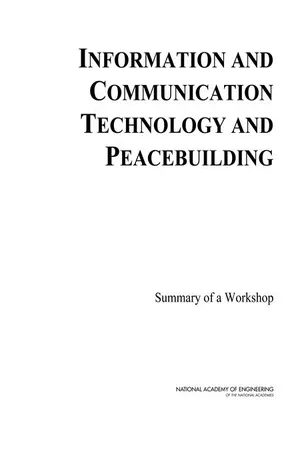
Those who would use information and communication technology (ICT) in the cause of peace need to be cognizant of the risks as well as the benefits. ICT can facilitate positive dialogue but also hate speech. It can be used to fight corruption but also facilitate it. Simply giving people more information does not necessarily lead to predictable or positive results. As people become more informed, they may become more motivated to change their circumstances and to do so violently.On December 14, 2007, the National Academy of Engineering (NAE) convened a group of experts in diverse fields to consider the role of ICT in promoting peace and conflict resolution. The one-day workshop was designed to consider current and emerging technologies and strategies for employing them in conflict management and diplomacy. It also aimed to explore how organizations with a role in promoting peace, like the U.S. Institute of Peace, can most effectively leverage technology in carrying out their missions.Information and Communication Technology and Peacebuilding: Summary of a Workshop reviews the group's discussions on number of key issues, illuminates certain practitioner needs, and suggests possible next steps.
- English
- ePUB (mobile friendly)
- Available on iOS & Android
eBook - ePub
About this book
Information
Topic
Computer ScienceIndex
Computer ScienceTable of contents
- COVER PAGE
- THE NATIONAL ACADEMIES
- STEERING COMMITTEE FOR NAE WORKSHOP ON THE USE OF INFORMATION and COMMUNICATION TECHNOLOGY IN PEACEBUILDING
- Preface
- Acknowledgments
- Contents
- OVERVIEW
- CONFLICT IN THE 21ST CENTURY
- PANEL 1 ICT IN THE CAUSE OF PEACE
- PANEL 2 IN THE FIELD: CHALLENGES AND OPPORTUNITIES
- DISCUSSION ABOUT NEXT STEPS
- FINAL COMMENTS
- Appendix A Workshop Agenda
- Appendix B Attendee ListNAE Workshop on the Use of ICT in Peacebuilding
- Appendix C Terms of Reference
- Appendix D Statement by Alan Kay2
- Appendix E4 Backgrounder on International Conflict
Trusted by 375,005 students
Access to over 1.5 million titles for a fair monthly price.
Study more efficiently using our study tools.
Frequently asked questions
Yes, you can cancel anytime from the Subscription tab in your account settings on the Perlego website. Your subscription will stay active until the end of your current billing period. Learn how to cancel your subscription
No, books cannot be downloaded as external files, such as PDFs, for use outside of Perlego. However, you can download books within the Perlego app for offline reading on mobile or tablet. Learn how to download books offline
Perlego offers two plans: Essential and Complete
- Essential is ideal for learners and professionals who enjoy exploring a wide range of subjects. Access the Essential Library with 800,000+ trusted titles and best-sellers across business, personal growth, and the humanities. Includes unlimited reading time and Standard Read Aloud voice.
- Complete: Perfect for advanced learners and researchers needing full, unrestricted access. Unlock 1.5M+ books across hundreds of subjects, including academic and specialized titles. The Complete Plan also includes advanced features like Premium Read Aloud and Research Assistant.
We are an online textbook subscription service, where you can get access to an entire online library for less than the price of a single book per month. With over 1.5 million books across 990+ topics, we’ve got you covered! Learn about our mission
Look out for the read-aloud symbol on your next book to see if you can listen to it. The read-aloud tool reads text aloud for you, highlighting the text as it is being read. You can pause it, speed it up and slow it down. Learn more about Read Aloud
Yes! You can use the Perlego app on both iOS and Android devices to read anytime, anywhere — even offline. Perfect for commutes or when you’re on the go.
Please note we cannot support devices running on iOS 13 and Android 7 or earlier. Learn more about using the app
Please note we cannot support devices running on iOS 13 and Android 7 or earlier. Learn more about using the app
Yes, you can access Information and Communication Technology and Peacebuilding by in PDF and/or ePUB format. We have over 1.5 million books available in our catalogue for you to explore.