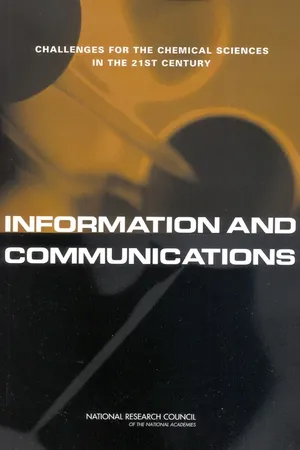
Since publication of the National Research Council (NRC) reports on chemistry in 1985 and chemical engineering in 1988, 1, 2 dramatic advances in information technology (IT) have totally changed these communities. During this period, the chemical enterprise and information technology have enjoyed both a remarkably productive and mutually supportive set of advances. These synergies sparked unprecedented growth in the capability and productivity of both fields including the definition of entirely new areas of the chemical enterprise. The chemical enterprise provided information technology with device fabrication processes, new materials, data, models, methods, and (most importantly) people. In turn, information technology provided chemical science and technology with truly remarkable and revolutionary resources for computations, communications, and data management. Indeed, computation has become the strong third component of the chemical science research and development effort, joining experiment and theory. Sustained mutual growth and interdependence of the chemical and information communities should take account of several unique aspects of the chemical sciences. These include extensive and complex databases that characterize the chemical disciplines; the importance of multiscale simulations that range from molecules to technological processes; the global economic impact of the chemical industry; and the industry's major influence on the nation's health, environment, security, and economic well-being. In planning the future of the chemical sciences and technology, it is crucial to recognize the benefits already derived from advances in information technology as well as to point the way to future benefits that will be derived.
- English
- ePUB (mobile friendly)
- Available on iOS & Android
eBook - ePub
About this book
Information
Edition
0Topic
Physical SciencesTable of contents
- COVER PAGE
- THE NATIONAL ACADEMIES
- ORGANIZING COMMITTEE: WORKSHOP ON INFORMATION AND COMMUNICATIONS
- COMMITTEE ON CHALLENGES FOR THE CHEMICAL SCIENCES IN THE 21ST CENTURY
- BOARD ON CHEMICAL SCIENCES AND TECHNOLOGY
- Preface
- Acknowledgment of Reviewers
- Contents
- Executive Summary
- 1 Introduction: The Human Resource
- 2 Accomplishments
- 3 Opportunities, Challenges, and Needs
- 4 Interfaces: Cooperation and Collaboration Across Disciplines
- 5 Infrastructure: Capabilities and Goals
- Appendixes
Trusted by 375,005 students
Access to over 1.5 million titles for a fair monthly price.
Study more efficiently using our study tools.
Frequently asked questions
Yes, you can cancel anytime from the Subscription tab in your account settings on the Perlego website. Your subscription will stay active until the end of your current billing period. Learn how to cancel your subscription
No, books cannot be downloaded as external files, such as PDFs, for use outside of Perlego. However, you can download books within the Perlego app for offline reading on mobile or tablet. Learn how to download books offline
Perlego offers two plans: Essential and Complete
- Essential is ideal for learners and professionals who enjoy exploring a wide range of subjects. Access the Essential Library with 800,000+ trusted titles and best-sellers across business, personal growth, and the humanities. Includes unlimited reading time and Standard Read Aloud voice.
- Complete: Perfect for advanced learners and researchers needing full, unrestricted access. Unlock 1.5M+ books across hundreds of subjects, including academic and specialized titles. The Complete Plan also includes advanced features like Premium Read Aloud and Research Assistant.
We are an online textbook subscription service, where you can get access to an entire online library for less than the price of a single book per month. With over 1.5 million books across 990+ topics, we’ve got you covered! Learn about our mission
Look out for the read-aloud symbol on your next book to see if you can listen to it. The read-aloud tool reads text aloud for you, highlighting the text as it is being read. You can pause it, speed it up and slow it down. Learn more about Read Aloud
Yes! You can use the Perlego app on both iOS and Android devices to read anytime, anywhere — even offline. Perfect for commutes or when you’re on the go.
Please note we cannot support devices running on iOS 13 and Android 7 or earlier. Learn more about using the app
Please note we cannot support devices running on iOS 13 and Android 7 or earlier. Learn more about using the app
Yes, you can access Information and Communications by in PDF and/or ePUB format. We have over 1.5 million books available in our catalogue for you to explore.