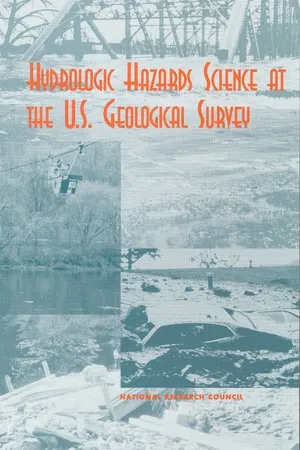
Losses of life and property in the United States-and throughout the world-resulting from hydrologic hazards, including floods, droughts, and related phenomena, are significant and increasing. Public awareness of, and federal attention to, natural disaster reduction, with a focus on mitigation or preparedness so as to minimize the impacts of such events, have probably never been greater than at present. With over three-quarters of federal disaster declarations resulting from water-related events, national interest in having the best-possible hydrologic data, information, and knowledge as the basis for assessment and reduction of risks from hydrologic hazards is clear.The U.S. Geological Survey (USGS) plays a variety of unique and critical roles relevant to hydrologic hazard understanding, preparedness, and response. The agency's data collection, research, techniques development, and interpretive studies provide the essential bases for national, state, and local hydrologic hazard risk assessment and reduction efforts. This work includes some of the more traditional activities of the Water Resources Division (e.g., streamflow measurement) and some of the more innovative interdisciplinary activities (e.g., hydrologic research, educational outreach, real-time data transmission, and risk communication) being pursued in cooperation with other divisions of the USGS, other federal and state agencies, and other local entities. This report aims to help shape a strategy and improve the overall framework of USGS efforts in these important areas.
- English
- ePUB (mobile friendly)
- Available on iOS & Android
eBook - ePub
About this book
Information
Edition
0Topic
Physical SciencesTable of contents
- COVER PAGE
- COMMITTEE ON U.S. GEOLOGICAL SURVEY WATER RESOURCES RESEARCH
- WATER SCIENCE AND TECHNOLOGY BOARD
- COMMISSION ON GEOSCIENCES, ENVIRONMENT, AND RESOURCES
- Preface
- Contents
- Executive Summary
- 1 Introduction
- 2 Water Management and Information Needs
- 3 Data Collection, Techniques Development, and Research
- 4 Interpretive Studies
- 5 Communicating Information on Hydrologic Hazards
- 6 Conclusions and Recommendations
- References
- Biographical Sketches of Committee Members
Trusted by 375,005 students
Access to over 1.5 million titles for a fair monthly price.
Study more efficiently using our study tools.
Frequently asked questions
Yes, you can cancel anytime from the Subscription tab in your account settings on the Perlego website. Your subscription will stay active until the end of your current billing period. Learn how to cancel your subscription
No, books cannot be downloaded as external files, such as PDFs, for use outside of Perlego. However, you can download books within the Perlego app for offline reading on mobile or tablet. Learn how to download books offline
Perlego offers two plans: Essential and Complete
- Essential is ideal for learners and professionals who enjoy exploring a wide range of subjects. Access the Essential Library with 800,000+ trusted titles and best-sellers across business, personal growth, and the humanities. Includes unlimited reading time and Standard Read Aloud voice.
- Complete: Perfect for advanced learners and researchers needing full, unrestricted access. Unlock 1.5M+ books across hundreds of subjects, including academic and specialized titles. The Complete Plan also includes advanced features like Premium Read Aloud and Research Assistant.
We are an online textbook subscription service, where you can get access to an entire online library for less than the price of a single book per month. With over 1.5 million books across 990+ topics, we’ve got you covered! Learn about our mission
Look out for the read-aloud symbol on your next book to see if you can listen to it. The read-aloud tool reads text aloud for you, highlighting the text as it is being read. You can pause it, speed it up and slow it down. Learn more about Read Aloud
Yes! You can use the Perlego app on both iOS and Android devices to read anytime, anywhere — even offline. Perfect for commutes or when you’re on the go.
Please note we cannot support devices running on iOS 13 and Android 7 or earlier. Learn more about using the app
Please note we cannot support devices running on iOS 13 and Android 7 or earlier. Learn more about using the app
Yes, you can access Hydrologic Hazards Science at the U.S. Geological Survey by in PDF and/or ePUB format. We have over 1.5 million books available in our catalogue for you to explore.