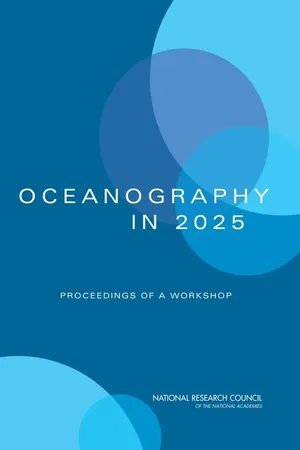
On January 8 and 9, 2009, the Ocean Studies Board of the National Research Council, in response to a request from the Office of Naval Research, hosted the "e;Oceanography in 2025"e; workshop. The goal of the workshop was to bring together scientists, engineers, and technologists to explore future directions in oceanography, with an emphasis on physical processes. The focus centered on research and technology needs, trends, and barriers that may impact the field of oceanography over the next 16 years, and highlighted specific areas of interest: submesoscale processes, air-sea interactions, basic and applied research, instrumentation and vehicles, ocean infrastructure, and education.To guide the white papers and drive discussions, four questions were posed to participants: What research questions could be answered?What will remain unanswered?What new technologies could be developed?How will research be conducted?
- English
- ePUB (mobile friendly)
- Available on iOS & Android
eBook - ePub
About this book
Information
Edition
0Topic
Physical SciencesTable of contents
- COVER PAGE
- THE NATIONAL ACADEMIES
- STEERING COMMITTEE ON OCEANOGRAPHY IN 2025: A WORKSHOP
- OCEAN STUDIES BOARD
- Preface
- Contents
- Introduction and Goals
- Integrated Oceanography in 2025
- Oceanography in 2028
- The Changing Relationship Between Humans and the Ocean
- Societal Implications for Ocean Research in 2025
- Oceanography in 2025: Responding to Growing Populations on a Rapidly Changing Planet
- Some Thoughts on Physical Oceanography in 2025
- The Next-Generation Coupled Atmosphere-Wave-Ocean- Ice-Land Models for Ocean Research and Prediction
- Science in Action, Episode 1: Exploring Boundaries
- Real Time Decision Support Everywhere
- Trends in Oceanography: More Data, More People, More Relevance
- Future Developments to Observational Physical Oceanography
- Prospects for Oceanography in 2025
- Oceanography in 2025
- Thoughts on Oceanography in 2025
- The Role of Observations in the Future of Oceanography
- The Future … One More Time
- The Role of Acoustics in Ocean Observing Systems
- Oceanography in 2025
- Physical Oceanography in 2025
- A Vision of Future Physical Oceanography Research
- Some Thoughts on Logistics, Mixing, and Power
- Ageostrophic Circulation in the Ocean
- The Future of Ocean Modeling
- Towards Nonhydrostatic Ocean Modeling with Large-eddy Simulation
- Simulations of Marine Turbulence and Surface Waves: Potential Impacts of Petascale Technology
- Computational Simulation and Submesoscale Variability
- Ocean Measurements from Space in 2025
- Future of Nearshore Processes Research
- Future Directions in Nearshore Oceanography
- Science Strategies for the Arctic Ocean
- Submesoscale Variability of the Upper Ocean: Patchy and Episodic Fluxes Into and Through Biologically Active Layers
- Who’s Blooming? Toward an Understanding of Why Certain Species Dominate Phytoplankton Blooms
- Understanding Phytoplankton Bloom Development
- From Short Food Chains to Complex Interaction Webs: Biological Oceanography in 2025
- The Interface Between Biological and Physical Processes
- Research on Higher Trophic Levels
- Marine Biogeochemistry in 2025
- Next-Generation Oceanographic Sensors for Short-Term Prediction/Verification of In-water Optical Conditions
- Evolution of Autonomous Platform for Sustained Ocean Observations
- Toward an Interdisciplinary Ocean Observing System in 2025
- Small Scale Ocean Dynamics in 2025
- Oceanography in 2025
- The Research Vessel Problem
- “Ocean Mapping” in 2025
- Seismic Oceanography: Imaging Oceanic Finestructure with Reflection Seismology
- The Ocean Planet 2.0: A Vision for 2025
- Force Projection Through the Littoral Zone: Optical Considerations
- Large Scale Phase-resolved Simulations of Ocean Surface Waves
- Appendixes
Trusted by 375,005 students
Access to over 1.5 million titles for a fair monthly price.
Study more efficiently using our study tools.
Frequently asked questions
Yes, you can cancel anytime from the Subscription tab in your account settings on the Perlego website. Your subscription will stay active until the end of your current billing period. Learn how to cancel your subscription
No, books cannot be downloaded as external files, such as PDFs, for use outside of Perlego. However, you can download books within the Perlego app for offline reading on mobile or tablet. Learn how to download books offline
Perlego offers two plans: Essential and Complete
- Essential is ideal for learners and professionals who enjoy exploring a wide range of subjects. Access the Essential Library with 800,000+ trusted titles and best-sellers across business, personal growth, and the humanities. Includes unlimited reading time and Standard Read Aloud voice.
- Complete: Perfect for advanced learners and researchers needing full, unrestricted access. Unlock 1.5M+ books across hundreds of subjects, including academic and specialized titles. The Complete Plan also includes advanced features like Premium Read Aloud and Research Assistant.
We are an online textbook subscription service, where you can get access to an entire online library for less than the price of a single book per month. With over 1.5 million books across 990+ topics, we’ve got you covered! Learn about our mission
Look out for the read-aloud symbol on your next book to see if you can listen to it. The read-aloud tool reads text aloud for you, highlighting the text as it is being read. You can pause it, speed it up and slow it down. Learn more about Read Aloud
Yes! You can use the Perlego app on both iOS and Android devices to read anytime, anywhere — even offline. Perfect for commutes or when you’re on the go.
Please note we cannot support devices running on iOS 13 and Android 7 or earlier. Learn more about using the app
Please note we cannot support devices running on iOS 13 and Android 7 or earlier. Learn more about using the app
Yes, you can access Oceanography in 2025 by in PDF and/or ePUB format. We have over 1.5 million books available in our catalogue for you to explore.