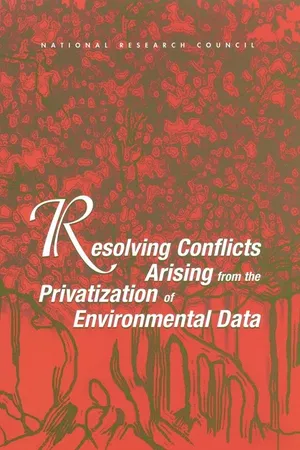
Reliable collections of science-based environmental information are vital for many groups of users and for a number of purposes. For example, electric utility companies predict demand during heat waves, structural engineers design buildings to withstand hurricanes and earthquakes, water managers monitor each winter's snow pack, and farmers plant and harvest crops based on daily weather predictions. Understanding the impact of human activities on climate, water, ecosystems, and species diversity, and assessing how natural systems may respond in the future are becoming increasingly important for public policy decisions.Environmental information systems gather factual information, transform it into information products, and distribute the products to users. Typical uses of the information require long-term consistency; hence the operation of the information system requires a long-term commitment from an institution, agency, or corporation. The need to keep costs down provides a strong motivation for creating multipurpose information systems that satisfy scientific, commercial and operational requirements, rather than systems that address narrow objectives. Resolving Conflicts Arising from the Privatization of Environmental Data focuses on such shared systems.
- 114 pages
- English
- PDF
- Available on iOS & Android
eBook - PDF
About this book
Information
Edition
0Topic
Physical SciencesTable of contents
- Resolving Conflicts Arising from the Privatization of Environmental Data
- Copyright
- Acknowledgments
- Preface
- Contents
- Executive Summary
- 1 Introduction
- 2 Stakeholder Viewpoints
- 3 Environmental Information Systems
- 4 Policy and Economic Framework for Public-Purpose Environmental Information Systems
- 5 War and Peace Among Stakeholders
- 6 Reconciling the Views of the Stakeholders
- Appendixes
Trusted by 375,005 students
Access to over 1.5 million titles for a fair monthly price.
Study more efficiently using our study tools.
Frequently asked questions
Yes, you can cancel anytime from the Subscription tab in your account settings on the Perlego website. Your subscription will stay active until the end of your current billing period. Learn how to cancel your subscription
No, books cannot be downloaded as external files, such as PDFs, for use outside of Perlego. However, you can download books within the Perlego app for offline reading on mobile or tablet. Learn how to download books offline
Perlego offers two plans: Essential and Complete
- Essential is ideal for learners and professionals who enjoy exploring a wide range of subjects. Access the Essential Library with 800,000+ trusted titles and best-sellers across business, personal growth, and the humanities. Includes unlimited reading time and Standard Read Aloud voice.
- Complete: Perfect for advanced learners and researchers needing full, unrestricted access. Unlock 1.5M+ books across hundreds of subjects, including academic and specialized titles. The Complete Plan also includes advanced features like Premium Read Aloud and Research Assistant.
We are an online textbook subscription service, where you can get access to an entire online library for less than the price of a single book per month. With over 1.5 million books across 990+ topics, we’ve got you covered! Learn about our mission
Look out for the read-aloud symbol on your next book to see if you can listen to it. The read-aloud tool reads text aloud for you, highlighting the text as it is being read. You can pause it, speed it up and slow it down. Learn more about Read Aloud
Yes! You can use the Perlego app on both iOS and Android devices to read anytime, anywhere — even offline. Perfect for commutes or when you’re on the go.
Please note we cannot support devices running on iOS 13 and Android 7 or earlier. Learn more about using the app
Please note we cannot support devices running on iOS 13 and Android 7 or earlier. Learn more about using the app
Yes, you can access Resolving Conflicts Arising from the Privatization of Environmental Data by in PDF and/or ePUB format. We have over 1.5 million books available in our catalogue for you to explore.