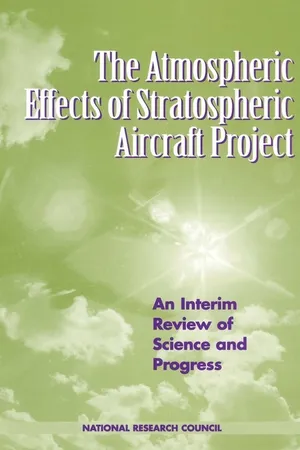
Scientists and policy-makers alike are concerned that operation of a fleet of high-speed civil transport (HSCT) aircraft could significantly affect the global atmosphere. HSCT emissions may have a direct effect on the chemistry of the atmosphere, leading to changes in the distribution of ozone; they may also have indirect effects on ozone and on global climate through coupling with radiative and dynamical processes in the atmosphere. An assessment of the atmospheric impact of a fleet of HSCTs thus requires not only an understanding of the chemistry of the natural stratosphere and its possible perturbations by HSCT emissions, but also an understanding of the pathways for transport of HSCT emissions within the atmosphere, and the resulting temporal and spatial distribution of HSCT emissions.The results of NASA's Atmospheric Effects of Stratospheric Aircraft (AESA) project were summarized in a 1995 NASA assessment. The present report looks at that summary and at more recent work to evaluate the state of the science. AESA has made good progress in the past few years. Satellite and aircraft observations have elucidated important aspects of large-scale transport processes. Field campaigns have provided a much better picture of the relative importance, below 20 km altitude, of the major catalytic cycles for ozone destruction. Careful intercomparisons of assessment models have led to reduction of some of the differences among the models. However, a number of uncertainties and inconsistencies still remain.
- English
- ePUB (mobile friendly)
- Available on iOS & Android
eBook - ePub
About this book
Information
Edition
0Topic
Physical SciencesTable of contents
- COVER PAGE
- PANEL ON THE ATMOSPHERIC EFFECTS OF AVIATION
- BOARD ON ATMOSPHERIC SCIENCES AND CLIMATE
- COMMISSION ON GEOSCIENCES, ENVIRONMENT, AND RESOURCES
- Preface
- Acknowledgment of Reviewers
- Contents
- Executive Summary
- 1 Introduction and History
- 2 Scientific Background for HSCT Concerns
- 3 Ozone Reduction by HSCT-Emitted Nitrogen Oxides
- 4 Outstanding Issues
- 5 Recommendations
- References
- Acronyms and Other Initialisms
Trusted by 375,005 students
Access to over 1.5 million titles for a fair monthly price.
Study more efficiently using our study tools.
Frequently asked questions
Yes, you can cancel anytime from the Subscription tab in your account settings on the Perlego website. Your subscription will stay active until the end of your current billing period. Learn how to cancel your subscription
No, books cannot be downloaded as external files, such as PDFs, for use outside of Perlego. However, you can download books within the Perlego app for offline reading on mobile or tablet. Learn how to download books offline
Perlego offers two plans: Essential and Complete
- Essential is ideal for learners and professionals who enjoy exploring a wide range of subjects. Access the Essential Library with 800,000+ trusted titles and best-sellers across business, personal growth, and the humanities. Includes unlimited reading time and Standard Read Aloud voice.
- Complete: Perfect for advanced learners and researchers needing full, unrestricted access. Unlock 1.5M+ books across hundreds of subjects, including academic and specialized titles. The Complete Plan also includes advanced features like Premium Read Aloud and Research Assistant.
We are an online textbook subscription service, where you can get access to an entire online library for less than the price of a single book per month. With over 1.5 million books across 990+ topics, we’ve got you covered! Learn about our mission
Look out for the read-aloud symbol on your next book to see if you can listen to it. The read-aloud tool reads text aloud for you, highlighting the text as it is being read. You can pause it, speed it up and slow it down. Learn more about Read Aloud
Yes! You can use the Perlego app on both iOS and Android devices to read anytime, anywhere — even offline. Perfect for commutes or when you’re on the go.
Please note we cannot support devices running on iOS 13 and Android 7 or earlier. Learn more about using the app
Please note we cannot support devices running on iOS 13 and Android 7 or earlier. Learn more about using the app
Yes, you can access Atmospheric Effects of Stratospheric Aircraft Project by in PDF and/or ePUB format. We have over 1.5 million books available in our catalogue for you to explore.