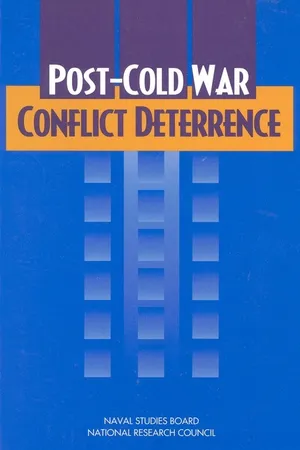
Deterrence as a strategic concept evolved during the Cold War. During that period, deterrence strategy was aimed mainly at preventing aggression against the United States and its close allies by the hostile Communist power centers--the Union of Soviet Socialist Republics (USSR) and its allies, Communist China and North Korea. In particular, the strategy was devised to prevent aggression involving nuclear attack by the USSR or China. Since the end of the Cold War, the risk of war among the major powers has subsided to the lowest point in modern history. Still, the changing nature of the threats to American and allied security interests has stimulated a considerable broadening of the deterrence concept.Post-Cold War Conflict Deterrence examines the meaning of deterrence in this new environment and identifies key elements of a post-Cold War deterrence strategy and the critical issues in devising such a strategy. It further examines the significance of these findings for the U.S. Navy and Marine Corps. Quantitative and qualitative measures to support judgments about the potential success or failure of deterrence are identified. Such measures will bear on the suitability of the naval forces to meet the deterrence objectives. The capabilities of U.S. naval forces that especially bear on the deterrence objectives also are examined. Finally, the book examines the utility of models, games, and simulations as decision aids in improving the naval forces' understanding of situations in which deterrence must be used and in improving the potential success of deterrence actions.
- English
- ePUB (mobile friendly)
- Available on iOS & Android
eBook - ePub
About this book
Information
Table of contents
- COVER PAGE
- PARTICIPANTS IN THE POST-COLD WAR CONFLICT DETERRENCE STUDY
- NAVAL STUDIES BOARD
- COMMISSION ON PHYSICAL SCIENCES, MATHEMATICS, AND APPLICATIONS
- Preface
- Contents
- Executive Summary
- 1 Deterrence: An Overview
- 2 IMPLICATIONS FOR DETERRENCE POLICY: TASKS FOR POLICY MAKERS
- 3 Significance of Post-Cold War Deterrence Concepts for the U.S. Navy and Marine Corps
- APPENDIX A Revising the Practice of Deterrence
- APPENDIX B Contemporary Strategic Deterrence and Precision-Guided Munitions
- APPENDIX C Extended Nuclear Deterrence and Coalitions for Defending Against Regional Challengers Armed with Weapons of Mass Destruction
- APPENDIX D The Remaining Unique Role of Nuclear Weapons in Post-Cold War Deterrence
- APPENDIX E Nuclear Weapons in Post-Cold War Deterrence
- APPENDIX F Notes on the "Band" Between "Existential Deterrence" and the Actual Use of Force
- APPENDIX G.1 Special Challenges in Extending Deterrence in the New Era
- APPENDIX G.2 Decision Modeling as an Aid to Strategic Planning and Crisis Action
- APPENDIX G.3 Protecting Weak and Medium-Strength States: Issues of Deterrence, Stability, and Decision Making
- APPENDIX H Theater Missile Defense, National IBM Systems, and the Future of Deterrence
- APPENDIX I Deterrence: Clash and Utilization of Value Systems
- APPENDIX J Controlling Instabilities Caused by Rogue Governments
- APPENDIX K Deterrence-Quo Vadis?
Trusted by 375,005 students
Access to over 1.5 million titles for a fair monthly price.
Study more efficiently using our study tools.
Frequently asked questions
Yes, you can cancel anytime from the Subscription tab in your account settings on the Perlego website. Your subscription will stay active until the end of your current billing period. Learn how to cancel your subscription
No, books cannot be downloaded as external files, such as PDFs, for use outside of Perlego. However, you can download books within the Perlego app for offline reading on mobile or tablet. Learn how to download books offline
Perlego offers two plans: Essential and Complete
- Essential is ideal for learners and professionals who enjoy exploring a wide range of subjects. Access the Essential Library with 800,000+ trusted titles and best-sellers across business, personal growth, and the humanities. Includes unlimited reading time and Standard Read Aloud voice.
- Complete: Perfect for advanced learners and researchers needing full, unrestricted access. Unlock 1.5M+ books across hundreds of subjects, including academic and specialized titles. The Complete Plan also includes advanced features like Premium Read Aloud and Research Assistant.
We are an online textbook subscription service, where you can get access to an entire online library for less than the price of a single book per month. With over 1.5 million books across 990+ topics, we’ve got you covered! Learn about our mission
Look out for the read-aloud symbol on your next book to see if you can listen to it. The read-aloud tool reads text aloud for you, highlighting the text as it is being read. You can pause it, speed it up and slow it down. Learn more about Read Aloud
Yes! You can use the Perlego app on both iOS and Android devices to read anytime, anywhere — even offline. Perfect for commutes or when you’re on the go.
Please note we cannot support devices running on iOS 13 and Android 7 or earlier. Learn more about using the app
Please note we cannot support devices running on iOS 13 and Android 7 or earlier. Learn more about using the app
Yes, you can access Post-Cold War Conflict Deterrence by in PDF and/or ePUB format. We have over 1.5 million books available in our catalogue for you to explore.