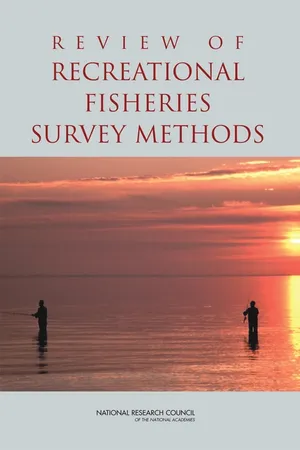
Recreational fishing in the United States is an important social and economic component of many marine fisheries, with an estimated 14 million anglers making almost 82 million fishing trips in 2004. Although each individual angler typically harvests a small number of fish, collectively these sport fisheries can take a significant fraction of the yearly catch--in some cases more than commercial fisheries. For example, in 1999, recreational fishing accounted for 94% of the total catch of spotted sea trout, 76% of striped bass and sheephead, and 60 percent of king mackerel. It is important that systems used to monitor fishing catch are adequate for timely management of recreational fisheries. However, the large number of anglers and access points makes monitoring recreational fishing much more difficult than monitoring commercial fishing. This report reviews the types of survey methods used to estimate catch in recreational fisheries, including state/federal cooperative programs. The report finds that both telephone survey and onsite access components of the current monitoring systems have serious flaws in design or implementation. There are also several areas of miscommunication and mismatched criteria among designers of surveys, data collectors, and recreational fisheries. The report recommends that a comprehensive, universal sampling frame with national coverage should be established, and that improvements should be made in statistical analysis of the data collected and in the ways the data are communicated. A permanent and independent research group should be established and funded to evaluate the statistical design and adequacy of recreational fishery surveys and to guide necessary modifications or new initiatives.
- English
- ePUB (mobile friendly)
- Available on iOS & Android
eBook - ePub
About this book
Information
Table of contents
- COVER PAGE
- THE NATIONAL ACADEMIES
- COMMITTEE ON THE REVIEW OF RECREATIONAL FISHERIES SURVEY METHODS
- OCEAN STUDIES BOARD
- Preface
- Acknowledgments
- Contents
- Summary
- 1 Introduction
- 2 Current Situation and Problems in Effort and Catch Estimation
- 3 Removal Estimation: Alternative Survey Design and Analysis Method
- 4 Data Requirements for Population Assessment
- 5 Human Dimensions
- 6 Program Management and Support
- 7 Communication and Outreach
- References
- Appendix A Committee and Staff Biographies
- Appendix B Existing Marine Recreational Fisheries Surveys
- Appendix C Fisheries Case Studies
- Appendix D Acronyms
Trusted by 375,005 students
Access to over 1.5 million titles for a fair monthly price.
Study more efficiently using our study tools.
Frequently asked questions
Yes, you can cancel anytime from the Subscription tab in your account settings on the Perlego website. Your subscription will stay active until the end of your current billing period. Learn how to cancel your subscription
No, books cannot be downloaded as external files, such as PDFs, for use outside of Perlego. However, you can download books within the Perlego app for offline reading on mobile or tablet. Learn how to download books offline
Perlego offers two plans: Essential and Complete
- Essential is ideal for learners and professionals who enjoy exploring a wide range of subjects. Access the Essential Library with 800,000+ trusted titles and best-sellers across business, personal growth, and the humanities. Includes unlimited reading time and Standard Read Aloud voice.
- Complete: Perfect for advanced learners and researchers needing full, unrestricted access. Unlock 1.5M+ books across hundreds of subjects, including academic and specialized titles. The Complete Plan also includes advanced features like Premium Read Aloud and Research Assistant.
We are an online textbook subscription service, where you can get access to an entire online library for less than the price of a single book per month. With over 1.5 million books across 990+ topics, we’ve got you covered! Learn about our mission
Look out for the read-aloud symbol on your next book to see if you can listen to it. The read-aloud tool reads text aloud for you, highlighting the text as it is being read. You can pause it, speed it up and slow it down. Learn more about Read Aloud
Yes! You can use the Perlego app on both iOS and Android devices to read anytime, anywhere — even offline. Perfect for commutes or when you’re on the go.
Please note we cannot support devices running on iOS 13 and Android 7 or earlier. Learn more about using the app
Please note we cannot support devices running on iOS 13 and Android 7 or earlier. Learn more about using the app
Yes, you can access Review of Recreational Fisheries Survey Methods by in PDF and/or ePUB format. We have over 1.5 million books available in our catalogue for you to explore.