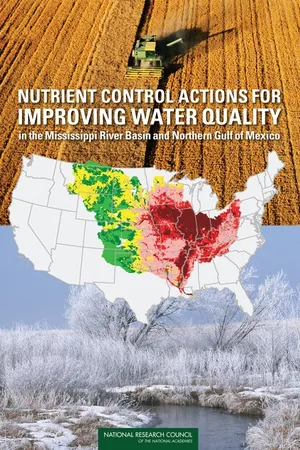
A large area of coastal waters in the northern Gulf of Mexico experiences seasonal conditions of low levels of dissolved oxygen, a condition known as hypoxia. Excess discharge of nutrients into the Gulf of Mexico from the Mississippi and Atchafalaya rivers causes nutrient overenrichment in the gulf's coastal waters and stimulates the growth of large algae blooms. When these algae die, the process of decomposition depletes dissolved oxygen from the water column and creates hypoxic conditions.In considering how to implement provisions of the Clean Water Act to strengthen nutrient reduction objectives across the Mississippi River basin, the U.S. Environmental Protection Agency (EPA) requested advice from the National Research Council. This book represents the results of the committee's investigations and deliberations, and recommends that the EPA and U.S. Department of Agriculture should jointly establish a Nutrient Control Implementation Initiative to learn more about the effectiveness of actions meant to improve water quality throughout the Mississippi River basin and into the northern Gulf of Mexico. Other recommendations include how to move forward on the larger process of allocating nutrient loading caps -- which entails delegating responsibilities for reducing nutrient pollutants such as nitrogen and phosphorus -- across the basin.
- English
- ePUB (mobile friendly)
- Available on iOS & Android
eBook - ePub
About this book
Information
Topic
Biological SciencesIndex
Biological SciencesTable of contents
- COVER PAGE
- THE NATIONAL ACADEMIES
- COMMITTEE ON THE MISSISSIPPI RIVER AND THE CLEAN WATER ACT: SCIENTIFIC, MODELING, AND TECHNICAL ASPECTS OF NUTRIENT POLLUTANT LOAD REDUCTION ALLOCATION AND IMPLEMENTATION
- WATER SCIENCE AND TECHNOLOGY BOARD
- Acknowledgment of Reviewers
- Contents
- Summary
- 1 Introduction
- 2 Nutrient Inputs and Water Quality Effects
- 3 Getting Started: A Nutrient Control Implementation Initiative (NCII)
- 4 Allocating Nutrient Load Reduction Targets
- 5 Monitoring the Effectiveness of Nutrient Control Actions and Strategies
- 6 Overcoming Perceived Obstacles to Action
- References
- Appendixes
Trusted by 375,005 students
Access to over 1.5 million titles for a fair monthly price.
Study more efficiently using our study tools.
Frequently asked questions
Yes, you can cancel anytime from the Subscription tab in your account settings on the Perlego website. Your subscription will stay active until the end of your current billing period. Learn how to cancel your subscription
No, books cannot be downloaded as external files, such as PDFs, for use outside of Perlego. However, you can download books within the Perlego app for offline reading on mobile or tablet. Learn how to download books offline
Perlego offers two plans: Essential and Complete
- Essential is ideal for learners and professionals who enjoy exploring a wide range of subjects. Access the Essential Library with 800,000+ trusted titles and best-sellers across business, personal growth, and the humanities. Includes unlimited reading time and Standard Read Aloud voice.
- Complete: Perfect for advanced learners and researchers needing full, unrestricted access. Unlock 1.5M+ books across hundreds of subjects, including academic and specialized titles. The Complete Plan also includes advanced features like Premium Read Aloud and Research Assistant.
We are an online textbook subscription service, where you can get access to an entire online library for less than the price of a single book per month. With over 1.5 million books across 990+ topics, we’ve got you covered! Learn about our mission
Look out for the read-aloud symbol on your next book to see if you can listen to it. The read-aloud tool reads text aloud for you, highlighting the text as it is being read. You can pause it, speed it up and slow it down. Learn more about Read Aloud
Yes! You can use the Perlego app on both iOS and Android devices to read anytime, anywhere — even offline. Perfect for commutes or when you’re on the go.
Please note we cannot support devices running on iOS 13 and Android 7 or earlier. Learn more about using the app
Please note we cannot support devices running on iOS 13 and Android 7 or earlier. Learn more about using the app
Yes, you can access Nutrient Control Actions for Improving Water Quality in the Mississippi River Basin and Northern Gulf of Mexico by in PDF and/or ePUB format. We have over 1.5 million books available in our catalogue for you to explore.