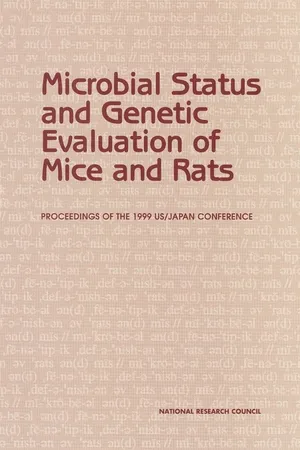
US/Japan meetings on laboratory animal science have been held virtually every year since 1980 under the US/Japan Cooperative Program on Science and Technology. Over the years these meetings have resulted in a number of important documents including the Manual of Microbiologic Monitoring of Laboratory Animals published in 1994 and the article Establishment and Preservation of Reference Inbred Strains of Rats for General Purposes. In addition to these publications, the meetings have been instrumental in increasing awareness of the need for microbiologic monitoring of laboratory rodents and the need for genetic definition and monitoring of mice and rats.In cooperation with the Comparative Medicine section of NCRR/NIH, the ILAR Council and staff are pleased to become the host for this important annual meeting and look forward to participating in future meetings. The support and sponsorship of NCRR (P40 RR 11611) in the United States and the Central Institute for Experimental Animals in Japan are gratefully acknowledged. Bringing together the leading scientists in the field of laboratory animal care has resulted in increased understanding of American and Japanese approaches to laboratory animal science and should continue to strengthen efforts to harmonize approaches aimed at resolving common challenges in the use of animal models for biomedical research and testing. This effort to improve understanding and cooperation between Japan and the United States should also be useful in developing similar interaction with other regions of the world including Europe, Australia, and Southeast Asia.
- English
- ePUB (mobile friendly)
- Available on iOS & Android
eBook - ePub
About this book
Information
Topic
Biological SciencesIndex
Biological SciencesTable of contents
- COVER PAGE
- THE NATIONAL ACADEMIES
- INTERNATIONAL COMMITTEE OF THE INSTITUTE FOR LABORATORY ANIMAL RESEARCH COUNCIL
- INSTITUTE FOR LABORATORY ANIMAL RESEARCH COUNCIL
- COMMISSION ON LIFE SCIENCES
- Preface
- Contents
- Opening Remarks
- Opening Remarks
- Introductory Comments on Microbiologic Testing of Laboratory Mice and Rats: Uniformity of Results
- Development of a Performance Assessment Program for Research Animal Diagnostic Laboratories and Defining Microbiologic Testing Standards
- Standardization of Rodent Health Surveillance: Regulation Versus Competition
- Factors Causing Difficulties in Uniformity of Results Among Testing Facilities in Microbiologic Monitoring of Laboratory Animals
- Necessity of Reexamining the Pathogenicity and Elimination of Parasites in Rats and Mice
- Emerging (and Reemerging) Viruses of Laboratory Mice and Rats
- Emerging Infections as a Cause of Concern
- Emerging Diseases in Mice and Rats
- Survey of Helicobacter Species in Laboratory Mice and Gerbils in Japan
- Genetic Evaluation of Outbred Rats
- Genetic Evaluation of Outbred Rats from the Breeder's Perspective
- Concept for Establishment of Rat Outbred Global Standard Strains
- Necessity of Genetic and Microbiologic Quality Network from the Pharmaceutical Industry's Perspective
- International Harmonization of Laboratory Animals
- Rat Genetics and Toxicology
- A Phenotype-driven Approach to the Molecular and Functional Analysis of the Mouse Genome
- Evaluation of Targeted Mutations
- Defining Behavioral Phenotypes in Transgenic and Knockout Mice
- Defining Phenotype in Genetically Engineered Mice
- Development of the Mouse Model Dramatype for Human Clinical Benefit
- Concluding Remarks
- Implication of Wild-derived Genes, Mitochondria, and Chromosomes in the Genetic Background of Mouse Models for Diseases and Biologic Functions
- Concluding Comments
- Concluding Comments
- Appendix A U.S./Japan Meeting November 15, 1999 Agenda
- Appendix B Meeting Participants
Trusted by 375,005 students
Access to over 1.5 million titles for a fair monthly price.
Study more efficiently using our study tools.
Frequently asked questions
Yes, you can cancel anytime from the Subscription tab in your account settings on the Perlego website. Your subscription will stay active until the end of your current billing period. Learn how to cancel your subscription
No, books cannot be downloaded as external files, such as PDFs, for use outside of Perlego. However, you can download books within the Perlego app for offline reading on mobile or tablet. Learn how to download books offline
Perlego offers two plans: Essential and Complete
- Essential is ideal for learners and professionals who enjoy exploring a wide range of subjects. Access the Essential Library with 800,000+ trusted titles and best-sellers across business, personal growth, and the humanities. Includes unlimited reading time and Standard Read Aloud voice.
- Complete: Perfect for advanced learners and researchers needing full, unrestricted access. Unlock 1.5M+ books across hundreds of subjects, including academic and specialized titles. The Complete Plan also includes advanced features like Premium Read Aloud and Research Assistant.
We are an online textbook subscription service, where you can get access to an entire online library for less than the price of a single book per month. With over 1.5 million books across 990+ topics, we’ve got you covered! Learn about our mission
Look out for the read-aloud symbol on your next book to see if you can listen to it. The read-aloud tool reads text aloud for you, highlighting the text as it is being read. You can pause it, speed it up and slow it down. Learn more about Read Aloud
Yes! You can use the Perlego app on both iOS and Android devices to read anytime, anywhere — even offline. Perfect for commutes or when you’re on the go.
Please note we cannot support devices running on iOS 13 and Android 7 or earlier. Learn more about using the app
Please note we cannot support devices running on iOS 13 and Android 7 or earlier. Learn more about using the app
Yes, you can access Microbial Status and Genetic Evaluation of Mice and Rats by in PDF and/or ePUB format. We have over 1.5 million books available in our catalogue for you to explore.