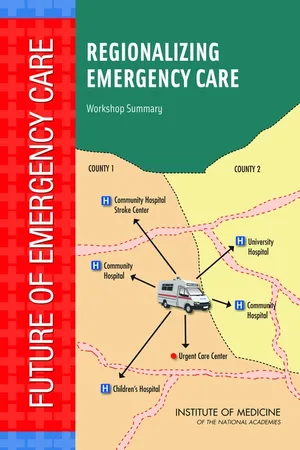
During medical emergencies, hospital staff and emergency medical services (EMS) providers, can face barriers in delivering the fastest and best possible care. Overcrowded emergency rooms cannot care for patients as quickly as necessary, and some may divert ambulances and turn away new patients outright. In many states, ambulance staff lacks the means to determine which hospitals can provide the best care to a patient. Given this absence of knowledge, they bring patients to the closest hospital. In addition, because emergency service providers from different companies compete with each other for patients, and emergency care legislation varies from state to state, it is difficult to establish the necessary local, interstate, and national communication and collaboration to create a more efficient system.In 2006, the IOM recommended that the federal government implement a regionalized emergency care system to improve cooperation and overcome these challenges. In a regionalized system, local hospitals and EMS providers would coordinate their efforts so that patients would be brought to hospitals based on the hospitals' capacity and expertise to best meet patients' needs. In September 2009, three years after making these recommendations, the IOM held a workshop sponsored by the federal Emergency Care Coordination Center to assess the nation's progress toward regionalizing emergency care. The workshop brought together policymakers and stakeholders, including nurses, EMS personnel, hospital administrators, and others involved in emergency care. Participants identified successes and shortcomings in previous regionalization efforts; examined the many factors involved in successfully implementing regionalization; and discussed future challenges to regionalizing emergency care. This document summarizes the workshop.
- English
- ePUB (mobile friendly)
- Available on iOS & Android
eBook - ePub
About this book
Information
Table of contents
- COVER PAGE
- THE NATIONAL ACADEMIES
- PLANNING COMMITTEE ON REGIONALIZING EMERGENCY CARE WORKSHOP1
- Reviewers
- Contents
- List of Figures and Boxes
- Overview
- Workshop Introduction
- 1 Regionalized Trauma Care: Past, Present, and Future
- 2 Emerging Models of Regionalization
- 3 Lessons from Other Systems
- 4 Regionalization: Potential and Pitfalls
- 5 Governance and Accountability
- 6 Financing
- 7 Data and Communications
- 8 Preparedness
- 9 Wrap-Up Discussion with Federal Partners
- Appendix A Workshop Agenda
- Appendix B Workshop Presenters* and Participants
- Appendix C The Future of Emergency Care: Key Findings and Recommendations from 2006 Study
Trusted by 375,005 students
Access to over 1.5 million titles for a fair monthly price.
Study more efficiently using our study tools.
Frequently asked questions
Yes, you can cancel anytime from the Subscription tab in your account settings on the Perlego website. Your subscription will stay active until the end of your current billing period. Learn how to cancel your subscription
No, books cannot be downloaded as external files, such as PDFs, for use outside of Perlego. However, you can download books within the Perlego app for offline reading on mobile or tablet. Learn how to download books offline
Perlego offers two plans: Essential and Complete
- Essential is ideal for learners and professionals who enjoy exploring a wide range of subjects. Access the Essential Library with 800,000+ trusted titles and best-sellers across business, personal growth, and the humanities. Includes unlimited reading time and Standard Read Aloud voice.
- Complete: Perfect for advanced learners and researchers needing full, unrestricted access. Unlock 1.5M+ books across hundreds of subjects, including academic and specialized titles. The Complete Plan also includes advanced features like Premium Read Aloud and Research Assistant.
We are an online textbook subscription service, where you can get access to an entire online library for less than the price of a single book per month. With over 1.5 million books across 990+ topics, we’ve got you covered! Learn about our mission
Look out for the read-aloud symbol on your next book to see if you can listen to it. The read-aloud tool reads text aloud for you, highlighting the text as it is being read. You can pause it, speed it up and slow it down. Learn more about Read Aloud
Yes! You can use the Perlego app on both iOS and Android devices to read anytime, anywhere — even offline. Perfect for commutes or when you’re on the go.
Please note we cannot support devices running on iOS 13 and Android 7 or earlier. Learn more about using the app
Please note we cannot support devices running on iOS 13 and Android 7 or earlier. Learn more about using the app
Yes, you can access Regionalizing Emergency Care by in PDF and/or ePUB format. We have over 1.5 million books available in our catalogue for you to explore.