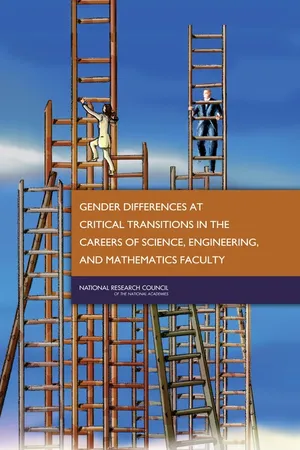
Gender Differences at Critical Transitions in the Careers of Science, Engineering, and Mathematics Faculty presents new and surprising findings about career differences between female and male full-time, tenure-track, and tenured faculty in science, engineering, and mathematics at the nation's top research universities. Much of this congressionally mandated book is based on two unique surveys of faculty and departments at major U.S. research universities in six fields: biology, chemistry, civil engineering, electrical engineering, mathematics, and physics. A departmental survey collected information on departmental policies, recent tenure and promotion cases, and recent hires in almost 500 departments. A faculty survey gathered information from a stratified, random sample of about 1, 800 faculty on demographic characteristics, employment experiences, the allocation of institutional resources such as laboratory space, professional activities, and scholarly productivity.This book paints a timely picture of the status of female faculty at top universities, clarifies whether male and female faculty have similar opportunities to advance and succeed in academia, challenges some commonly held views, and poses several questions still in need of answers. This book will be of special interest to university administrators and faculty, graduate students, policy makers, professional and academic societies, federal funding agencies, and others concerned with the vitality of the U.S. research base and economy.
- 385 pages
- English
- PDF
- Available on iOS & Android
eBook - PDF
About this book
Information
Topic
Social SciencesIndex
Social SciencesTable of contents
- FrontMatter
- Preface
- Acknowledgments
- Contents
- List of Tables and Figures
- Summary
- 1 Introduction
- 2 Status of Women in Academic Science and Engineering in 2004 and 2005
- 3 Gender Differences in Academic Hiring
- 4 Professional Activities, Institutional Resources, Climate, and Outcomes
- 5 Gender Differences in Tenure and Promotion
- 6 Key Findings and Recommendations
- Appendixes
- Appendix 1-1: Biographical Information on Committee Members
- Appendix 1-2: List of Research I Institutions
- Appendix 1-3: Committee Meeting Agenda
- Appendix 1-4: The Surveys
- Appendix 1-5: Survey Instruments
- Appendix 1-6: Departments in Survey
- Appendix 2-1: Review of Literature and Relevant Research
- Appendix 2-2: Previous Research on Factors Contributing to Gender Differences Among Faculty
- Appendix 3-1: Review of Literature and Research on Factors Associated with a Higher Proportion of Female Applicants
- Appendix 3-2: Estimated Adjusted Mean Effects and Differences for the Probability That There Are No Female Applicants
- Appendix 3-3: Estimated Adjusted Mean Effects and Differences Based on the Modeled Probability of the Percentage of Applicants That Are Female
- Appendix 3-4: Estimated Adjusted Mean Effects and Differences Based on the Modeled Probability of at Least One Female Candidate Interviewed
- Appendix 3-5: Doctoral Degrees Awarded by All Doctoral-Granting Institutions, by Field, Gender, and Year
- Appendix 3-6: Doctoral Degrees Awarded by Discipline and Gender for Research I Institutions, 1999-2003
- Appendix 3-7: Marginal Mean and Variance of Transformed Response Variables
- Appendix 3-8: Main Considerations for Taking a Position by Number of Respondents Saying “Yes”
- Appendix 4-1: Distribution of Undergraduate Course Load for Faculty by Gender and Discipline
- Appendix 4-2: Percentage of Faculty Members Who Do No Graduate Teaching
- Appendix 4-3: Percentage of Faculty Members Receiving a Reduced Teaching Load When Hired
- Appendix 4-4: Percentage of Faculty Members Who Served on an Undergraduate Thesis or Honors Committee
- Appendix 4-5: Percentage of Faculty Members Who Served on and Chaired an Undergraduate Thesis or Honors Committee
- Appendix 4-6: Distribution of Number of Graduate Thesis or Honors Committees for Research I Tenure and Tenure-Track Faculty: Men/Women
- Appendix 4-7: Percentage of Time Spent in Administration or Committee Work on Campus and Service to the Profession Outside the University for Tenured and Tenure-Track Faculty at Research I Institutions: Men/Women
- Appendix 4-8: Distribution of Number of Service Committees for Research I Tenure and Tenure-Track Faculty: Men/Women
- Appendix 4-9: Mean Salary by Gender and Professorial Rank for Tenure and Tenure-Track Faculty in Research I Institutions
- Appendix 4-10: Percentage of Tenured and Tenure-Track Faculty in Research I Institutions Receiving Summer Support
- Appendix 4-11: Percentage of Tenured and Tenure-Track Faculty in Research I Institutions Receiving Travel Funds
- Appendix 4-12: Median Square Footage of Lab Space of Faculty Who Report Doing Experimental Work
- Appendix 4-13: Faculty Who Have Received More Lab Space Since Hire (Values Are Percentages)
- Appendix 4-14: Percentage of Tenured and Tenure-Track Faculty in Research I Institutions Receiving Sufficient Equipment
- Appendix 4-15: Number of Postdoctorate Students for Tenured and Tenure-Track Faculty in Research I Institutions (presented by Men and Women)
- Appendix 4-16: Percentage of Tenured and Tenure-Track Faculty in Research I Institutions Receiving Sufficient Clerical Support
- Appendix 4-17: Percentage of Faculty Members Stating That They Had a Mentor
- Appendix 4-18: Distribution of the Number of Graduate Students for Tenured and Tenure-Track Faculty in Research I Institutions (presented by Men and Women)
- Appendix 4-19: Mean Number of Articles Published in Refereed Journals (sole and co-authored) Over the Past 3 Years for Tenured and Tenure-Track Faculty in Research I Institutions
- Appendix 4-20a: Estimated Probability of Having Grant Funding by Discipline, Gender, and Whether the Faculty Member Has an Assigned Mentor—Assistant Professors Only
- Appendix 4-20b: Estimated Probability of Having Grant Funding by Discipline, Gender, and Whether the Faculty Member Has an Assigned Mentor—Associate Professors Only
- Appendix 4-21: Percentage of Faculty Missing Salary Data by Gender and Discipline
- Appendix 4-22: Percentage of Tenured and Tenure-Track Faculty at Research I Institutions That Were Nominated for at Least One Award
- Appendix 4-23: Percentage of Tenured and Tenure-Track Research I Faculty with Offers to Leave
- Appendix 4-24: Percentage of Tenured and Tenure-Track Faculty at Research I Institutions Planning to Leave or Retire
- Appendix 5-1: Knowledge of Tenure Procedures by Gender, Rank, and Presence of a Mentor
- Appendix 5-2: Detailed Tenure Information from Departmental Survey
- Appendix 5-3: Time Spent in Both Assistant and Associate Professorships
- Appendix 5-4: Years Between Starting Employment and Achieving Associate Professor Status, by Gender
- Appendix 5-5: Years Between Starting Employment and Achieving Full Professor Status, by Gender
- Appendix 5-6: Patterns of Nonresponse for Tenure Decisions
- Appendix 5-7: Patterns of Nonresponse for Promotion Decisions
- Bibliography
- Index
Trusted by 375,005 students
Access to over 1.5 million titles for a fair monthly price.
Study more efficiently using our study tools.
Frequently asked questions
Yes, you can cancel anytime from the Subscription tab in your account settings on the Perlego website. Your subscription will stay active until the end of your current billing period. Learn how to cancel your subscription
No, books cannot be downloaded as external files, such as PDFs, for use outside of Perlego. However, you can download books within the Perlego app for offline reading on mobile or tablet. Learn how to download books offline
Perlego offers two plans: Essential and Complete
- Essential is ideal for learners and professionals who enjoy exploring a wide range of subjects. Access the Essential Library with 800,000+ trusted titles and best-sellers across business, personal growth, and the humanities. Includes unlimited reading time and Standard Read Aloud voice.
- Complete: Perfect for advanced learners and researchers needing full, unrestricted access. Unlock 1.5M+ books across hundreds of subjects, including academic and specialized titles. The Complete Plan also includes advanced features like Premium Read Aloud and Research Assistant.
We are an online textbook subscription service, where you can get access to an entire online library for less than the price of a single book per month. With over 1.5 million books across 990+ topics, we’ve got you covered! Learn about our mission
Look out for the read-aloud symbol on your next book to see if you can listen to it. The read-aloud tool reads text aloud for you, highlighting the text as it is being read. You can pause it, speed it up and slow it down. Learn more about Read Aloud
Yes! You can use the Perlego app on both iOS and Android devices to read anytime, anywhere — even offline. Perfect for commutes or when you’re on the go.
Please note we cannot support devices running on iOS 13 and Android 7 or earlier. Learn more about using the app
Please note we cannot support devices running on iOS 13 and Android 7 or earlier. Learn more about using the app
Yes, you can access Gender Differences at Critical Transitions in the Careers of Science, Engineering, and Mathematics Faculty by in PDF and/or ePUB format. We have over 1.5 million books available in our catalogue for you to explore.