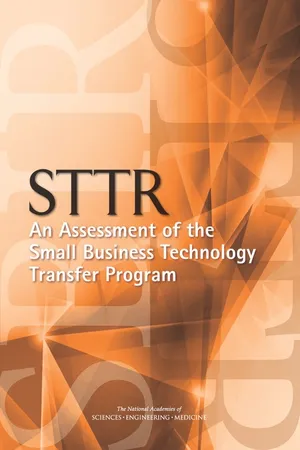
Today's knowledge economy is driven in large part by the nation's capacity to innovate. One of the defining features of the U.S. economy is a high level of entrepreneurial activity. Entrepreneurs in the United States see opportunities and are willing and able to assume risk to bring new welfare-enhancing, wealth-generating technologies to the market. Yet, although discoveries in areas such as genomics, bioinformatics, and nanotechnology present new opportunities, converting these discoveries into innovations for the market involves substantial challenges. The American capacity for innovation can be strengthened by addressing the challenges faced by entrepreneurs. Public-private partnerships are one means to help entrepreneurs bring new ideas to market.The Small Business Technology Transfer (STTR) and the Small Business Innovation Research (SBIR) program form one of the largest examples of U.S. public-private partnerships. In the SBIR Reauthorization Act of 2000, Congress tasked the National Research Council with undertaking a comprehensive study of how the SBIR program has stimulated technological innovation and used small businesses to meet federal research and development needs and with recommending further improvements to the program. When reauthorizing the SBIR and STTR programs in 2011, Congress expanded the study mandate to include a review of the STTR program. This report builds on the methodology and outcomes from the previous review of SBIR and assesses the STTR program.
- English
- ePUB (mobile friendly)
- Available on iOS & Android
eBook - ePub
About this book
Information
Table of contents
- COVER PAGE
- TITLE PAGE
- COPYRIGHT PAGE
- TABLE OF CONTENTS
- SUMMARY
- 1. Introduction
- 2. Program Management
- 3. Applications and Awards
- 4. Qualitative Assessment: Company and University Perspectives
- 5. Quantitative Outcomes
- 6. Findings and Recommendations
- APPENDIXES
Trusted by 375,005 students
Access to over 1.5 million titles for a fair monthly price.
Study more efficiently using our study tools.
Frequently asked questions
Yes, you can cancel anytime from the Subscription tab in your account settings on the Perlego website. Your subscription will stay active until the end of your current billing period. Learn how to cancel your subscription
No, books cannot be downloaded as external files, such as PDFs, for use outside of Perlego. However, you can download books within the Perlego app for offline reading on mobile or tablet. Learn how to download books offline
Perlego offers two plans: Essential and Complete
- Essential is ideal for learners and professionals who enjoy exploring a wide range of subjects. Access the Essential Library with 800,000+ trusted titles and best-sellers across business, personal growth, and the humanities. Includes unlimited reading time and Standard Read Aloud voice.
- Complete: Perfect for advanced learners and researchers needing full, unrestricted access. Unlock 1.5M+ books across hundreds of subjects, including academic and specialized titles. The Complete Plan also includes advanced features like Premium Read Aloud and Research Assistant.
We are an online textbook subscription service, where you can get access to an entire online library for less than the price of a single book per month. With over 1.5 million books across 990+ topics, we’ve got you covered! Learn about our mission
Look out for the read-aloud symbol on your next book to see if you can listen to it. The read-aloud tool reads text aloud for you, highlighting the text as it is being read. You can pause it, speed it up and slow it down. Learn more about Read Aloud
Yes! You can use the Perlego app on both iOS and Android devices to read anytime, anywhere — even offline. Perfect for commutes or when you’re on the go.
Please note we cannot support devices running on iOS 13 and Android 7 or earlier. Learn more about using the app
Please note we cannot support devices running on iOS 13 and Android 7 or earlier. Learn more about using the app
Yes, you can access STTR: An Assessment of the Small Business Technology Transfer Program by in PDF and/or ePUB format. We have over 1.5 million books available in our catalogue for you to explore.