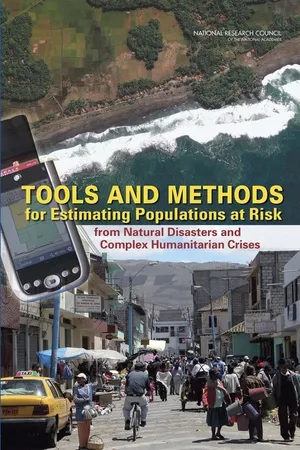
Worldwide, millions of people are displaced annually because of natural or industrial disasters or social upheaval. Reliable data on the numbers, characteristics, and locations of these populations can bolster humanitarian relief efforts and recovery programs. Using sound methods for estimating population numbers and characteristics is important for both industrialized and developing nations. Ensuring that the data are geographically referenced for projection onto maps is essential. However, good data alone are insufficient. Adequate staff training and strong organizational and political desire to maintain and use the information are also required. Tools and Methods for Estimating Populations at Risk from Natural Disasters and Complex Humanitarian Crises, reviews the main methods and tools for making estimates of subnational populations and makes several recommendations to improve the collection and the use of population data for emergency response and development.
- 265 pages
- English
- PDF
- Available on iOS & Android
eBook - PDF
About this book
Information
Topic
Social SciencesIndex
Social SciencesTable of contents
- Frontmatter
- Preface
- Acknowledgments
- Contents
- Summary
- 1 Populations at Risk: Local to Global Concerns
- 2 Current Status of At-Risk Subnational Population Estimation
- 3 Data Dissonance in Disasters
- 4 The Operational Environment and Institutional Impediments
- 5 Population Data and Crisis Responsein Mali, Mozambique, and Haiti
- 6 Recommendations
- Appendix A Biographical Sketches ofCommittee Members and Staff
- Appendix B Acronyms and Abbreviations
- AppendixC Glossary
- Appendix D Workshop and Meeting Agendas and Attendees
- Appendix E Technical Papers
Trusted by 375,005 students
Access to over 1.5 million titles for a fair monthly price.
Study more efficiently using our study tools.
Frequently asked questions
Yes, you can cancel anytime from the Subscription tab in your account settings on the Perlego website. Your subscription will stay active until the end of your current billing period. Learn how to cancel your subscription
No, books cannot be downloaded as external files, such as PDFs, for use outside of Perlego. However, you can download books within the Perlego app for offline reading on mobile or tablet. Learn how to download books offline
Perlego offers two plans: Essential and Complete
- Essential is ideal for learners and professionals who enjoy exploring a wide range of subjects. Access the Essential Library with 800,000+ trusted titles and best-sellers across business, personal growth, and the humanities. Includes unlimited reading time and Standard Read Aloud voice.
- Complete: Perfect for advanced learners and researchers needing full, unrestricted access. Unlock 1.5M+ books across hundreds of subjects, including academic and specialized titles. The Complete Plan also includes advanced features like Premium Read Aloud and Research Assistant.
We are an online textbook subscription service, where you can get access to an entire online library for less than the price of a single book per month. With over 1.5 million books across 990+ topics, we’ve got you covered! Learn about our mission
Look out for the read-aloud symbol on your next book to see if you can listen to it. The read-aloud tool reads text aloud for you, highlighting the text as it is being read. You can pause it, speed it up and slow it down. Learn more about Read Aloud
Yes! You can use the Perlego app on both iOS and Android devices to read anytime, anywhere — even offline. Perfect for commutes or when you’re on the go.
Please note we cannot support devices running on iOS 13 and Android 7 or earlier. Learn more about using the app
Please note we cannot support devices running on iOS 13 and Android 7 or earlier. Learn more about using the app
Yes, you can access Tools and Methods for Estimating Populations at Risk from Natural Disasters and Complex Humanitarian Crises by in PDF and/or ePUB format. We have over 1.5 million books available in our catalogue for you to explore.