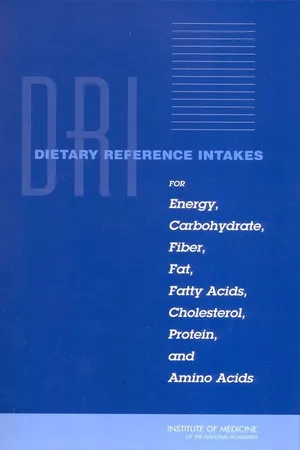
Responding to the expansion of scientific knowledge about the roles of nutrients in human health, the Institute of Medicine has developed a new approach to establish Recommended Dietary Allowances (RDAs) and other nutrient reference values. The new title for these values Dietary Reference Intakes (DRIs), is the inclusive name being given to this new approach. These are quantitative estimates of nutrient intakes applicable to healthy individuals in the United States and Canada. This new book is part of a series of books presenting dietary reference values for the intakes of nutrients. It establishes recommendations for energy, carbohydrate, fiber, fat, fatty acids, cholesterol, protein, and amino acids. This book presents new approaches and findings which include the following: The establishment of Estimated Energy Requirements at four levels of energy expenditureRecommendations for levels of physical activity to decrease risk of chronic diseaseThe establishment of RDAs for dietary carbohydrate and proteinThe development of the definitions of Dietary Fiber, Functional Fiber, and Total FiberThe establishment of Adequate Intakes (AI) for Total FiberThe establishment of AIs for linolenic and a-linolenic acidsAcceptable Macronutrient Distribution Ranges as a percent of energy intake for fat, carbohydrate, linolenic and a-linolenic acids, and proteinResearch recommendations for information needed to advance understanding of macronutrient requirements and the adverse effects associated with intake of higher amountsAlso detailed are recommendations for both physical activity and energy expenditure to maintain health and decrease the risk of disease.
- 1,359 pages
- English
- PDF
- Available on iOS & Android
eBook - PDF
About this book
Information
Table of contents
- FrontMatter
- Dedication
- Preface
- Contents
- Summary
- 1 Introduction to Dietary Reference Intakes
- 2 Methods and Approaches Used
- 3 Relationship of Macronutrients and Physical Activity to Chronic Disease
- 4 A Model for the Development of Tolerable Upper Intake Levels
- 5 Energy
- 6 Dietary Carbohydrates: Sugars and Starches
- 7 Dietary, Functional, and Total Fiber
- 8 Dietary Fats: Total Fat and Fatty Acids
- 9 Cholesterol
- 10 Protein and Amino Acids
- 11 Macronutrients and Healthful Diets
- 12 Physical Activity
- 13 Applications of Dietary Reference Intakes for Macronutrients
- 14 A Research Agenda
- APPENDIXES
- A Glossary and Acronyms
- B Origin and Framework of the Development of Dietary Reference Intakes
- C Acknowledgments
- D Dietary Intake Data from the Third National Health and Nutrition Examination Survey (NHANES III), 1988–1994
- E Dietary Intake Data from the Continuing Survey of Food Intakes by Individuals (CSFII), 1994–1996, 1998
- F Canadian Dietary Intake Data, 1990–1997
- G Special Analyses for Dietary Fats
- H Body Composition Data Based on the Third National Health and Nutrition Examination Survey (NHANES III), 1988–1994
- I Doubly Labeled Water Data Used to Predict Energy Expenditure
- J Association of Added Sugars Intake and Intake of Other Nutrients
- K Data Comparing Carbohydrate Intake to Intake of Other Nutrients from the Continuing Survey of Food Intakes by Individuals (CSFII), 1994–1996, 1998
- L Options for Dealing with Uncertainties
- M Nitrogen Balance Studies Used to Estimate the Protein Requirements in Adults
- Biographical Sketches of Panel and Subcommittee Members
- Index
- Summary Tables, Dietary Reference Intakes
Trusted by 375,005 students
Access to over 1.5 million titles for a fair monthly price.
Study more efficiently using our study tools.
Frequently asked questions
Yes, you can cancel anytime from the Subscription tab in your account settings on the Perlego website. Your subscription will stay active until the end of your current billing period. Learn how to cancel your subscription
No, books cannot be downloaded as external files, such as PDFs, for use outside of Perlego. However, you can download books within the Perlego app for offline reading on mobile or tablet. Learn how to download books offline
Perlego offers two plans: Essential and Complete
- Essential is ideal for learners and professionals who enjoy exploring a wide range of subjects. Access the Essential Library with 800,000+ trusted titles and best-sellers across business, personal growth, and the humanities. Includes unlimited reading time and Standard Read Aloud voice.
- Complete: Perfect for advanced learners and researchers needing full, unrestricted access. Unlock 1.5M+ books across hundreds of subjects, including academic and specialized titles. The Complete Plan also includes advanced features like Premium Read Aloud and Research Assistant.
We are an online textbook subscription service, where you can get access to an entire online library for less than the price of a single book per month. With over 1.5 million books across 990+ topics, we’ve got you covered! Learn about our mission
Look out for the read-aloud symbol on your next book to see if you can listen to it. The read-aloud tool reads text aloud for you, highlighting the text as it is being read. You can pause it, speed it up and slow it down. Learn more about Read Aloud
Yes! You can use the Perlego app on both iOS and Android devices to read anytime, anywhere — even offline. Perfect for commutes or when you’re on the go.
Please note we cannot support devices running on iOS 13 and Android 7 or earlier. Learn more about using the app
Please note we cannot support devices running on iOS 13 and Android 7 or earlier. Learn more about using the app
Yes, you can access Dietary Reference Intakes for Energy, Carbohydrate, Fiber, Fat, Fatty Acids, Cholesterol, Protein, and Amino Acids by in PDF and/or ePUB format. We have over 1.5 million books available in our catalogue for you to explore.