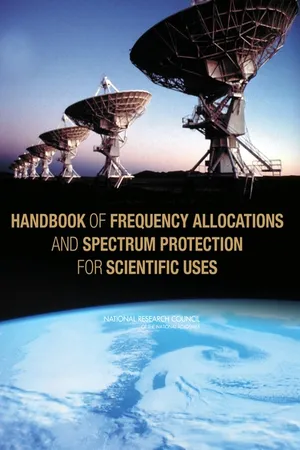
The electromagnetic spectrum is a vital part of our environment. Information encoded in the spectrum of radiation arriving at earth from the universe is the means by which we learn about its workings and origin. Radiation collected from the Earth's land, oceans, biosphere, and atmosphere provide us with much of the data needed to better understand this environment. Wise use of the spectrum is necessary if we are to continue these advances in scientific understanding. To help guide this effort, the NSF and NASA asked the NRC to develop a set of principles for fostering effective allocation and protection of spectral bands for scientific research. This handbook contains practical information in this connection including a description of regulatory bodies and issues, a discussion of the relevant scientific background, a list of science spectrum allocations in the United States, and an analysis of spectrum protection issues.
- 131 pages
- English
- PDF
- Available on iOS & Android
eBook - PDF
About this book
Information
Table of contents
- FrontMatter
- Preface
- Acknowledgments
- Acknowledgment of Reviewers
- Contents
- Summary
- 1 Radio-Frequency Regulation
- 2 The Scientific Background
- 3 Science Service Allocations
- 4 Technical Aspects of Protection for the Scientific Use of the Radio Spectrum
- Appendixes
- Appendix A Definitions of Terms
- Appendix B Information on Footnotes to Science Services Allocations
- Appendix C International Astronomical Union Spectral Lines of Most Importance Below 300 GHz
- Appendix D International Astronomical Union Spectral Lines of Most Importance Above 300 GHz
- Appendix E Selected Rules and Regulations of the Federal Communications Commission
- Appendix F Titles of ITU Recommendations for Radio Astronomy and for Space Applications and Meteorology
- Appendix G Earth Science Passive Sensor Needs Above 71 GHz
- Appendix H Use of 0 dBi for Sidelobe Gain in Calculations of Interference in Radio Astronomy Bands
- Appendix I Selected Acronyms/Abbreviations and Footnote Designations
Trusted by 375,005 students
Access to over 1.5 million titles for a fair monthly price.
Study more efficiently using our study tools.
Frequently asked questions
Yes, you can cancel anytime from the Subscription tab in your account settings on the Perlego website. Your subscription will stay active until the end of your current billing period. Learn how to cancel your subscription
No, books cannot be downloaded as external files, such as PDFs, for use outside of Perlego. However, you can download books within the Perlego app for offline reading on mobile or tablet. Learn how to download books offline
Perlego offers two plans: Essential and Complete
- Essential is ideal for learners and professionals who enjoy exploring a wide range of subjects. Access the Essential Library with 800,000+ trusted titles and best-sellers across business, personal growth, and the humanities. Includes unlimited reading time and Standard Read Aloud voice.
- Complete: Perfect for advanced learners and researchers needing full, unrestricted access. Unlock 1.5M+ books across hundreds of subjects, including academic and specialized titles. The Complete Plan also includes advanced features like Premium Read Aloud and Research Assistant.
We are an online textbook subscription service, where you can get access to an entire online library for less than the price of a single book per month. With over 1.5 million books across 990+ topics, we’ve got you covered! Learn about our mission
Look out for the read-aloud symbol on your next book to see if you can listen to it. The read-aloud tool reads text aloud for you, highlighting the text as it is being read. You can pause it, speed it up and slow it down. Learn more about Read Aloud
Yes! You can use the Perlego app on both iOS and Android devices to read anytime, anywhere — even offline. Perfect for commutes or when you’re on the go.
Please note we cannot support devices running on iOS 13 and Android 7 or earlier. Learn more about using the app
Please note we cannot support devices running on iOS 13 and Android 7 or earlier. Learn more about using the app
Yes, you can access Handbook of Frequency Allocations and Spectrum Protection for Scientific Uses by in PDF and/or ePUB format. We have over 1.5 million books available in our catalogue for you to explore.