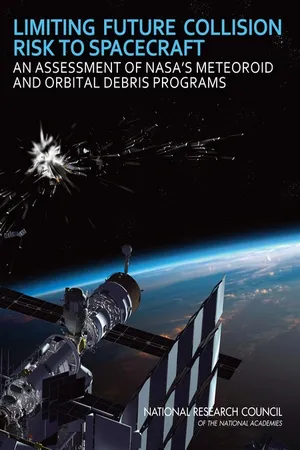
Derelict satellites, equipment and other debris orbiting Earth (aka space junk) have been accumulating for many decades and could damage or even possibly destroy satellites and human spacecraft if they collide. During the past 50 years, various National Aeronautics and Space Administration (NASA) communities have contributed significantly to maturing meteoroid and orbital debris (MMOD) programs to their current state. Satellites have been redesigned to protect critical components from MMOD damage by moving critical components from exterior surfaces to deep inside a satellite's structure. Orbits are monitored and altered to minimize the risk of collision with tracked orbital debris. MMOD shielding added to the International Space Station (ISS) protects critical components and astronauts from potentially catastrophic damage that might result from smaller, untracked debris and meteoroid impacts.Limiting Future Collision Risk to Spacecraft: An Assessment of NASA's Meteoroid and Orbital Debris Program examines NASA's efforts to understand the meteoroid and orbital debris environment, identifies what NASA is and is not doing to mitigate the risks posed by this threat, and makes recommendations as to how they can improve their programs. While the report identified many positive aspects of NASA's MMOD programs and efforts including responsible use of resources, it recommends that the agency develop a formal strategic plan that provides the basis for prioritizing the allocation of funds and effort over various MMOD program needs. Other necessary steps include improvements in long-term modeling, better measurements, more regular updates of the debris environmental models, and other actions to better characterize the long-term evolution of the debris environment.
- 179 pages
- English
- PDF
- Available on iOS & Android
eBook - PDF
About this book
Information
Table of contents
- FrontMatter
- Preface
- Acknowledgment of Reviewers
- Contents
- Summary
- 1 Introduction and Historical Background
- 2 Orbital Debris Environment: Detection and Monitoring
- 3 Orbital Debris Modeling and Simulation
- 4 The Meteoroid Environment and Its Effects on Spacecraft
- 5 Risk Assessment and Uncertainty
- 6 Spacecraft Protection in the MMOD Environment
- 7 Mitigation of Orbital Debris
- 8 Hazards Posed by Reentry of Orbital Debris
- 9 Conjunction Assessment Risk Analysis and Launch Collision Avoidance
- 10 Spacecraft Anomalies
- 11 Issues External to NASA
- 12 Management and Organizational Issues
- 13 Preparing for the Future
- 14 Compiled List of Findings and Recommendations
- Appendixes
- Appendix A: Letter of Request
- Appendix B: Statement of Task
- Appendix C: Committee and Staff Biographical Information
- Appendix D: Acronyms
- Appendix E: Glossary
- Appendix F: Reprinted Workshop Report
Trusted by 375,005 students
Access to over 1.5 million titles for a fair monthly price.
Study more efficiently using our study tools.
Frequently asked questions
Yes, you can cancel anytime from the Subscription tab in your account settings on the Perlego website. Your subscription will stay active until the end of your current billing period. Learn how to cancel your subscription
No, books cannot be downloaded as external files, such as PDFs, for use outside of Perlego. However, you can download books within the Perlego app for offline reading on mobile or tablet. Learn how to download books offline
Perlego offers two plans: Essential and Complete
- Essential is ideal for learners and professionals who enjoy exploring a wide range of subjects. Access the Essential Library with 800,000+ trusted titles and best-sellers across business, personal growth, and the humanities. Includes unlimited reading time and Standard Read Aloud voice.
- Complete: Perfect for advanced learners and researchers needing full, unrestricted access. Unlock 1.5M+ books across hundreds of subjects, including academic and specialized titles. The Complete Plan also includes advanced features like Premium Read Aloud and Research Assistant.
We are an online textbook subscription service, where you can get access to an entire online library for less than the price of a single book per month. With over 1.5 million books across 990+ topics, we’ve got you covered! Learn about our mission
Look out for the read-aloud symbol on your next book to see if you can listen to it. The read-aloud tool reads text aloud for you, highlighting the text as it is being read. You can pause it, speed it up and slow it down. Learn more about Read Aloud
Yes! You can use the Perlego app on both iOS and Android devices to read anytime, anywhere — even offline. Perfect for commutes or when you’re on the go.
Please note we cannot support devices running on iOS 13 and Android 7 or earlier. Learn more about using the app
Please note we cannot support devices running on iOS 13 and Android 7 or earlier. Learn more about using the app
Yes, you can access Limiting Future Collision Risk to Spacecraft by in PDF and/or ePUB format. We have over 1.5 million books available in our catalogue for you to explore.