The United States and the former Soviet Union have sent spacecraft to mars as early as 1966, with Mars' exploration being priority for NASA spacecraft. Both sides, however, have failed as well as succeed. The inability to determine if life exists on Mars is considered one of NASA's failures and undercut political support for additional Mars missions in the U.S. until the launch of the Mars Observer in 1992. Thus, the exploration of life on Mars continues, but with a new approach. Assessment of NASA's Mars Architecture, 2007-2016 is an assessment by the Committee to Review the Next Decade Mars Architecture of the National Research Council (NRC) conducted by request of Dr. Mary Cleave, NASA's Associate Administrator for the Science Mission Directorate. The Committee addresses the following questions: Is the Mars architecture reflective of the strategies, priorities, and guidelines put forward by the National Research Council's solar system exploration decadal survey and related science strategies and NASA plans?, Does the revised Mars architecture address the goals of NASA's Mars Exploration Program and optimize the science return, given the current fiscal posture of the program?, and Does the Mars architecture represent a reasonably balanced mission portfolio? After several months of study, consideration and incorporation of the guidance from NRC studies, especially New Frontiers in the Solar System, and the Vision for Space Exploration; community consultations via individual inputs; and a MEPAG-sponsored working group, a plan was created. This report includes the plan, which has an Astrobiology Field Laboratory or two Mild Rovers mission planned for 2016, recommendations from the committee, NRC guidelines for mars exploration, and more.
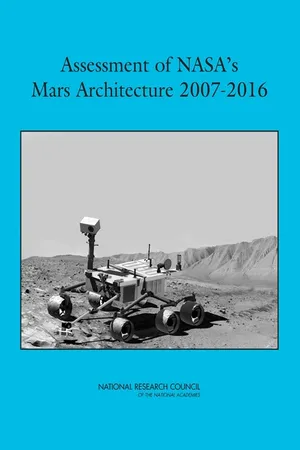
- 63 pages
- English
- PDF
- Available on iOS & Android
eBook - PDF
About this book
Information
Edition
0Topic
Physical SciencesTable of contents
- FrontMatter
- Preface
- Contents
- Executive Summary
- 1 Introduction
- 2 NRC Strategies, Priorities, and Guidelines for the Exploration of Mars
- 3 The Goals of NASA’s Mars Program
- 4 A Balanced Mission Portfolio
- 5 Summary
- Appendixes
- A SSE Decadal Survey Mars Priorities
- B MEPAG Goals and Objectives
- C Acronyms
Trusted by 375,005 students
Access to over 1.5 million titles for a fair monthly price.
Study more efficiently using our study tools.
Frequently asked questions
Yes, you can cancel anytime from the Subscription tab in your account settings on the Perlego website. Your subscription will stay active until the end of your current billing period. Learn how to cancel your subscription
No, books cannot be downloaded as external files, such as PDFs, for use outside of Perlego. However, you can download books within the Perlego app for offline reading on mobile or tablet. Learn how to download books offline
Perlego offers two plans: Essential and Complete
- Essential is ideal for learners and professionals who enjoy exploring a wide range of subjects. Access the Essential Library with 800,000+ trusted titles and best-sellers across business, personal growth, and the humanities. Includes unlimited reading time and Standard Read Aloud voice.
- Complete: Perfect for advanced learners and researchers needing full, unrestricted access. Unlock 1.5M+ books across hundreds of subjects, including academic and specialized titles. The Complete Plan also includes advanced features like Premium Read Aloud and Research Assistant.
We are an online textbook subscription service, where you can get access to an entire online library for less than the price of a single book per month. With over 1.5 million books across 990+ topics, we’ve got you covered! Learn about our mission
Look out for the read-aloud symbol on your next book to see if you can listen to it. The read-aloud tool reads text aloud for you, highlighting the text as it is being read. You can pause it, speed it up and slow it down. Learn more about Read Aloud
Yes! You can use the Perlego app on both iOS and Android devices to read anytime, anywhere — even offline. Perfect for commutes or when you’re on the go.
Please note we cannot support devices running on iOS 13 and Android 7 or earlier. Learn more about using the app
Please note we cannot support devices running on iOS 13 and Android 7 or earlier. Learn more about using the app
Yes, you can access Assessment of NASA's Mars Architecture 2007-2016 by in PDF and/or ePUB format. We have over 1.5 million books available in our catalogue for you to explore.