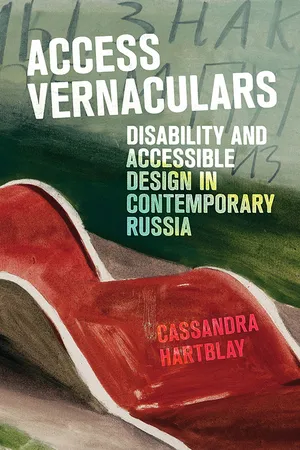
Access Vernaculars
Disability and Accessible Design in Contemporary Russia
- English
- ePUB (mobile friendly)
- Available on iOS & Android
About this book
Access Vernaculars explores moments when accessible design fails. Observing how both disabled and nondisabled people in Russia recognize and point out poorly executed accessible design in built environments, ethnographer Cassandra Hartblay traces how disabled people in one Russian city narrate experiences of pervasive inaccess, and interprets popular images of failed accessibility as critiques of the Russian state and ablenationalism. In the process, Hartblay asks how disability advocacy movements proceed when ablenationalism co-opts accessibility and calls for a critical global disability studies that pushes back against Euro-American hegemony.
Through the stories disabled people tell about access and inaccess, this book examines local terminology used by those with mobility impairments to describe the built environment—a unique lexicon combining translated terms from global disability advocacy with Russophone words inherited from generations of political advocacy. These ethnographic accounts demonstrate the ways vocabularies of disability access spread in friction, taking on dynamic and unexpected meanings in transnational sociopolitical contexts. Access Vernaculars presents a global perspective on the intersection of critical disability studies and sociocultural anthropology.
Frequently asked questions
- Essential is ideal for learners and professionals who enjoy exploring a wide range of subjects. Access the Essential Library with 800,000+ trusted titles and best-sellers across business, personal growth, and the humanities. Includes unlimited reading time and Standard Read Aloud voice.
- Complete: Perfect for advanced learners and researchers needing full, unrestricted access. Unlock 1.4M+ books across hundreds of subjects, including academic and specialized titles. The Complete Plan also includes advanced features like Premium Read Aloud and Research Assistant.
Please note we cannot support devices running on iOS 13 and Android 7 or earlier. Learn more about using the app.
Information
Table of contents
- Cover Page
- Title Page
- Contents
- List of Figures
- Note on Translation and Transliteration
- Introduction
- 1. “I Can Do It Myself”: The Politics of Disability Politics, 1990–2008
- 2. Inaccessible Accessibility: Ramps in Global Friction
- 3. Housing Fates: Negotiating Homespace Barriers in the Material Afterlife of Soviet Socialism
- 4. Normal, Convenient, Comfortable: Lexicons of Access in Urban Modernity
- Conclusion: Heroes and Protagonists of Russian Crip Futures
- Acknowledgments
- Notes
- References
- Index
- Copyright Page