The powerful story of how the War on Terror created the conditions for the emergence of a novel theory of jihad
On March 7th, 2007, three Muslim university students left their small city on the Canadian Prairies, seemingly without a trace. In the ensuing months, their disappearance raised fears among Canadian and US security agencies that the men had become "radicalized," posing a grave threat to national security. From presidential briefings and targeted drone assassinations to a politically charged trial in a Brooklyn courtroom, the men's story sheds new light not only on the figure of the "radical," but also on the "moderate" Muslim, represented by a community forever changed by the men's departure.
Homegrown Radicals offers a case study of the complex entanglements of the radical and moderate Muslim in post-9/11 North America. Youcef Soufi brings these figures together in uneasy tension, providing insight into how state violence has inextricably tied them together. Focusing on the radicalization of the three Muslim students, the book traces the general sense of affective injury among North American Muslims over the loss of Muslim life in Western military campaigns overseas.
In this context, a new theory of jihad rooted in a Muslim utopian imagination emerged, marking a significant rupture with premodern Islamic thought. The three "radicals" were among thousands of Anglophone Muslims who found this new theory compelling as both a diagnosis and a solution to the violence unleashed in the War on Terror. The book examines how and why this theory resonated, as well as its consequences for the men's families, friends, and Muslim community.
Homegrown Radicals highlights how post-9/11 Islamophobia has operated through the conceptual blurring of the line between "moderate" and "radical" Muslims, and asks what alternative forms of solidarity may transcend the violent boundaries of the nation-state.
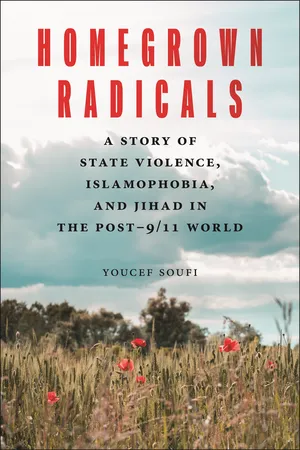
eBook - ePub
Homegrown Radicals
A Story of State Violence, Islamophobia, and Jihad in the Post-9/11 World
- English
- ePUB (mobile friendly)
- Available on iOS & Android
eBook - ePub
Homegrown Radicals
A Story of State Violence, Islamophobia, and Jihad in the Post-9/11 World
About this book
Information
Subtopic
RadicalismTable of contents
- Cover
- Title Page
- Copyright Page
- Dedication
- Contents
- Introduction: “They Found Him”
- 1 Can the Muslim Speak? Grief, Suspicion, and Social Responsibility
- 2 Lives That Mattered and Lives That Didn’t: Muslim Canadians and the War on Terror
- 3 The Emergence of the Homegrown Jihadist
- 4 Under Suspicion: Targeting, Harassment, and Abuse of Power
- 5 “I Want Out”: Disillusionment with Utopian Jihad
- 6 Prosecuting Terrorism: National Security, Treason, and the Impossibility of Justice
- Epilogue
- Acknowledgments
- Notes
- Index
- About the Author
Trusted by 375,005 students
Access to over 1.5 million titles for a fair monthly price.
Study more efficiently using our study tools.
Frequently asked questions
Yes, you can cancel anytime from the Subscription tab in your account settings on the Perlego website. Your subscription will stay active until the end of your current billing period. Learn how to cancel your subscription
No, books cannot be downloaded as external files, such as PDFs, for use outside of Perlego. However, you can download books within the Perlego app for offline reading on mobile or tablet. Learn how to download books offline
Perlego offers two plans: Essential and Complete
- Essential is ideal for learners and professionals who enjoy exploring a wide range of subjects. Access the Essential Library with 800,000+ trusted titles and best-sellers across business, personal growth, and the humanities. Includes unlimited reading time and Standard Read Aloud voice.
- Complete: Perfect for advanced learners and researchers needing full, unrestricted access. Unlock 1.5M+ books across hundreds of subjects, including academic and specialized titles. The Complete Plan also includes advanced features like Premium Read Aloud and Research Assistant.
We are an online textbook subscription service, where you can get access to an entire online library for less than the price of a single book per month. With over 1.5 million books across 990+ topics, we’ve got you covered! Learn about our mission
Look out for the read-aloud symbol on your next book to see if you can listen to it. The read-aloud tool reads text aloud for you, highlighting the text as it is being read. You can pause it, speed it up and slow it down. Learn more about Read Aloud
Yes! You can use the Perlego app on both iOS and Android devices to read anytime, anywhere — even offline. Perfect for commutes or when you’re on the go.
Please note we cannot support devices running on iOS 13 and Android 7 or earlier. Learn more about using the app
Please note we cannot support devices running on iOS 13 and Android 7 or earlier. Learn more about using the app
Yes, you can access Homegrown Radicals by Youcef Soufi in PDF and/or ePUB format, as well as other popular books in Politics & International Relations & Radicalism. We have over 1.5 million books available in our catalogue for you to explore.