- English
- ePUB (mobile friendly)
- Available on iOS & Android
About this book
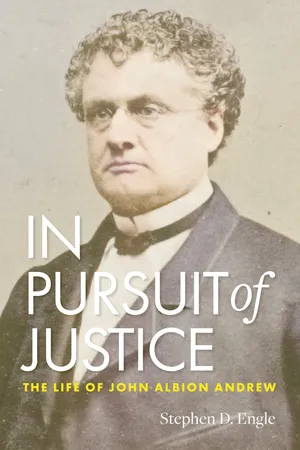
Widely known as the "poor man's lawyer" in antebellum Boston, John Albion Andrew (1818â1867) was involved in nearly every cause and case that advanced social and racial justice in Boston in the years preceding the Civil War. Inspired by the legacies of John Quincy Adams and Ralph Waldo Emerson, and mentored by Charles Sumner, Andrew devoted himself to the battle for equality. By day, he fought to protect those condemned to the death penalty, women seeking divorce, and fugitives ensnared by the Fugitive Slave Law. By night, he coordinated logistics and funding for the Underground Railroad as it ferried enslaved African Americans northward.
In this revealing and accessible biography, Stephen D. Engle traces Andrew's life and legacy, giving this important, but largely forgotten, figure his due. Rising to national prominence during the Civil War years as the governor of Massachusetts, Andrew raised the African American regiment known as the Glorious 54th and rallied thousands of soldiers to the Union cause. Upon his sudden death in 1867, a correspondent for Harper's Weekly wrote, "Not since the news came of Abraham Lincoln's death were so many hearts truly smitten."
Frequently asked questions
- Essential is ideal for learners and professionals who enjoy exploring a wide range of subjects. Access the Essential Library with 800,000+ trusted titles and best-sellers across business, personal growth, and the humanities. Includes unlimited reading time and Standard Read Aloud voice.
- Complete: Perfect for advanced learners and researchers needing full, unrestricted access. Unlock 1.4M+ books across hundreds of subjects, including academic and specialized titles. The Complete Plan also includes advanced features like Premium Read Aloud and Research Assistant.
Please note we cannot support devices running on iOS 13 and Android 7 or earlier. Learn more about using the app.
Information
Table of contents
- CoverÂ
- Half Title
- Title
- Copyright
- Contents
- List of Illustrations
- Preface
- Acknowledgments
- Chapter 1: Windham Origins: 1818â1833
- Chapter 2: The Bowdoin College Years: 1834â1837
- Chapter 3: The Poor Manâs Lawyer: 1837â1845
- Chapter 4: The Emerging Politician: 1846â1849
- Chapter 5: On the Right Side of God: 1850â1854
- Chapter 6: The Republican Tide: 1855â1856
- Chapter 7: The Radical Champion: 1857â1858
- Chapter 8: Republican Star Rising: 1858â1859
- Chapter 9: The Governorship: 1860
- Chapter 10: Man for the Hour: JanuaryâApril 1861
- Chapter 11: A Grand Era Has Dawned: AprilâMay 1861
- Chapter 12: Communities at War: JuneâSeptember 1861
- Chapter 13: The Politics of Command: OctoberâNovember 1861
- Chapter 14: The Lord Is Marching On: November 1861âJanuary 1862
- Chapter 15: The Changing War: JanuaryâJuly 1862
- Chapter 16: Emancipation: JulyâNovember 1862
- Chapter 17: Slaves No More: December 1862âMay 1863
- Chapter 18: Opening Eyes of North and South: MayâDecember 1863
- Chapter 19: The Promise of a New Year: JanuaryâJune 1864
- Chapter 20: This Justice: JulyâDecember 1864
- Chapter 21: Thirteenth Amendment: JanuaryâJune 1865
- Chapter 22: Last Months in the Statehouse: JulyâDecember 1865
- Chapter 23: Working for the Ages: JanuaryâApril 1866
- Chapter 24: Postwar Yankee: May 1866âMay 1867
- Epilogue: Children Will Call You Blessed: April 1866âOctober 1897
- Notes
- Bibliography
- Index
- Back Cover