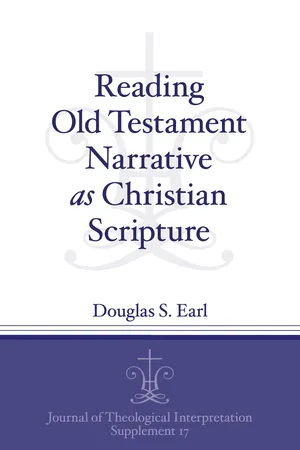
Douglas Earl sets out a fresh perspective on understanding what is involved in reading Old Testament narrative as Christian Scripture. Earl considers various narratives as examples that model different interpretive challenges in the form of exegetical, ethical, historical, metaphysical, and theological difficulties. Using these examples, the significance of interpretive approaches focused on authorial intention, history of composition, canonical context, reception history, and reading context are considered in conjunction with spiritual, literary, structuralist, existential, historical-critical, and ethical-critical approaches. Christian interpretation of Scripture as Scripture is shown to be an inherently ad hoc task, understood as a rule-governed practice in Wittgenstein's sense: an established goal-directed activity for which no method, hermeneutical principle, or critical perspective discovers "meaning" or generates good interpretation. Good interpretation involves exploration of various construals of the "world of the text" using "hermeneutics of tradition" and "critique of ideology" (Ricoeur). The interpreter's task is to discern faithful readings and develop their significance in a given intellectual or cultural context. The interpretation of Scripture and its appropriation is seen to involve wisdom in forming judgments on a case-by-case basis, learned through examples and experience, on what constitutes good interpretation and use. Earl shows how traditional hermeneutics and contemporary critical resources suggest that history, ethics, and theology can rarely be "read off" Old Testament narrative, but also how Christians can appropriate ethically and historically problematic books such as Joshua, faithfully adopt a "minimalist" approach to 1-2 Samuel, and embrace a Trinitarian reading of Genesis 1.
- 384 pages
- English
- PDF
- Available on iOS & Android
eBook - PDF
Reading Old Testament Narrative as Christian Scripture
About this book
Information
Table of contents
- COVER Front
- Copyright Page
- Table of CONTENTS
- Chapter 1: PROLOGUE
- Chapter 2: ANALYSIS OF WHY AN OLD TESTMAN NARRATIVE HAS FAILED TO FIND CHRISTAN SIGNIFICANCE USING LiTERARY POETICS AND NEO- STRUCTURALISM -
- Chapter 3 : JOSHUA 1-12
- Chapter 4: THE JOSEPH STORY (GENESIS 37-50) THE HERMENEUTICAL SIGNIFICANCE OF THE RECEPTION HISTORY AND THE LITERARY HORIZONS OF THREE THEOLOGICALLY PROBLEMATIC TEXTS
- Chapter 5: THE DAVID STORY THE HERMENEUTICAL AND THEOLOGICAL SIGNIFICANCE OF (MINIMAlISM)
- Chapter 6: RAHAB AND DINAH REVISITED: "READING AS" SCRIPTURE THROUGH PSSIBLE CONSTUALS OF THE "WORLD OF THE TEXT" IN CHRISTIAN CONTEXTS
- Chapter 7: THE STORY OF RUTH RELATIONSHIPS BETWEEN THE READER, CHRISTIAN ETHICS AND OLD TESTMENT NARRATIVE
- Chapter 8: GENESIS 1:26: CHRISTIAN THEOLOGY, METAPHYSICS, AND OLD TESTMENT NARRATIVE
- Chapter 9: SALVATION HISTORY A FRAMEWORK FOR OLD TESTMENT INTERPRETATION ? THE SECONDNAIVETE,THE PATRISTIC CONCEPT OF OIKONOMIA AND MYTH
- Chapter 10 READING OLD TESTMENT NARRAITIVE AS CHRISTIAN SCRIPTURE AS A TASK BEST LEFT JAGGED
- BIBLIOGRAPHY
- INDEX
Trusted by 375,005 students
Access to over 1.5 million titles for a fair monthly price.
Study more efficiently using our study tools.
Frequently asked questions
Yes, you can cancel anytime from the Subscription tab in your account settings on the Perlego website. Your subscription will stay active until the end of your current billing period. Learn how to cancel your subscription
No, books cannot be downloaded as external files, such as PDFs, for use outside of Perlego. However, you can download books within the Perlego app for offline reading on mobile or tablet. Learn how to download books offline
Perlego offers two plans: Essential and Complete
- Essential is ideal for learners and professionals who enjoy exploring a wide range of subjects. Access the Essential Library with 800,000+ trusted titles and best-sellers across business, personal growth, and the humanities. Includes unlimited reading time and Standard Read Aloud voice.
- Complete: Perfect for advanced learners and researchers needing full, unrestricted access. Unlock 1.5M+ books across hundreds of subjects, including academic and specialized titles. The Complete Plan also includes advanced features like Premium Read Aloud and Research Assistant.
We are an online textbook subscription service, where you can get access to an entire online library for less than the price of a single book per month. With over 1.5 million books across 990+ topics, we’ve got you covered! Learn about our mission
Look out for the read-aloud symbol on your next book to see if you can listen to it. The read-aloud tool reads text aloud for you, highlighting the text as it is being read. You can pause it, speed it up and slow it down. Learn more about Read Aloud
Yes! You can use the Perlego app on both iOS and Android devices to read anytime, anywhere — even offline. Perfect for commutes or when you’re on the go.
Please note we cannot support devices running on iOS 13 and Android 7 or earlier. Learn more about using the app
Please note we cannot support devices running on iOS 13 and Android 7 or earlier. Learn more about using the app
Yes, you can access Reading Old Testament Narrative as Christian Scripture by Douglas S. Earl in PDF and/or ePUB format, as well as other popular books in Theology & Religion & Biblical Criticism & Interpretation. We have over 1.5 million books available in our catalogue for you to explore.