A little over two decades ago, Zimbabwe undertook its Fast Track Land Reform Programme. Critics saw it as nothing more than an assault on human and property rights for political expedience by a ruling elite that was fast losing its power. In contrast, those sympathetic to the land reform program saw it as fundamental to the righting of colonialism’s historical wrongs. Yet, rural displacements at the hands of state actors, or of those closely connected to them, continue. As in the past, the continuing land conflicts are mostly understood as the result of the actions of an authoritarian state that exploits its control of land for the political and economic benefit of those who inhabit it. These explanations share one thing in common: each understands the country’s perpetual land questions in terms of the actions or inactions of the colonial or the postcolonial state.
This book refocuses attention on how regimes of power rooted in kinship, gender, generation, and status have, individually and in combination, informed access to land in precolonial northeastern Zimbabwe. It then examines how these regimes of power interacted with colonial policies to inform the African experience in colonial Zimbabwe. Further, the book places land and the ability to ensure its fecundity at the center of the making and moderation of precolonial political power and how this power was impacted by the imposition of colonial rule.
Tracing the dynamics of land and power from precolonial times, together with their entanglement with colonial policies, is important, for this relationship is almost always neglected by both scholars and policymakers drawn to the high drama of colonial and postcolonial politics of land. This oversight has real consequences on our understandings of landed inequalities and how they are addressed. When Zimbabwe’s postcolonial state focused on colonially induced racialized land inequalities, its land reform efforts left older forms of landed inequalities based on gender, generation, and ideas of belonging intact. The book, which details these inequalities, reminds Zimbabweans and others that if the quest for equity espoused in postcolonial land reforms is to be meaningful, it must be attentive to both colonially induced inequalities and those enduring disparities that predated, were deepened by, and outlived colonial rule. At the same time, Zimbabweans who now live with a postcolonial state that is increasingly centralizing power over land may well learn from past societies’ creative efforts to limit the authority of their leaders.
- English
- ePUB (mobile friendly)
- Available on iOS & Android
eBook - ePub
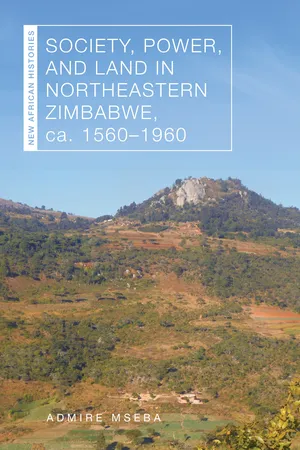
Society, Power, and Land in Northeastern Zimbabwe, ca. 1560–1960
About this book
Information
Subtopic
African HistoryIndex
HistoryTable of contents
- Cover
- Series Page
- Title Page
- Copyright
- Contents
- List of Illustrations
- Preface
- Acknowledgments
- Abbreviations
- Introduction. Power and the Deep History of Zimbabwe’s Land Question
- Chapter 1. Knowing the Land, Marking Social Hierarchies, and Legitimating Claims to Land and Power
- Chapter 2. In the Shadow of Kingdoms
- Chapter 3. Changing Geographies and Old Registers of Power
- Chapter 4. Imagining Traditions, Making Authority
- Chapter 5. Changes in the Law
- Chapter 6. Accessing Land and Contesting Authority outside the Reserves of Northeastern Zimbabwe
- Postscript. The Longue Durée, the Recent Past, and the Nexus between Land and Power
- Appendix A. Language Relationships
- Appendix B. Lexical Items
- Notes
- Bibliography
- Index
Trusted by 375,005 students
Access to over 1.5 million titles for a fair monthly price.
Study more efficiently using our study tools.
Frequently asked questions
Yes, you can cancel anytime from the Subscription tab in your account settings on the Perlego website. Your subscription will stay active until the end of your current billing period. Learn how to cancel your subscription
No, books cannot be downloaded as external files, such as PDFs, for use outside of Perlego. However, you can download books within the Perlego app for offline reading on mobile or tablet. Learn how to download books offline
Perlego offers two plans: Essential and Complete
- Essential is ideal for learners and professionals who enjoy exploring a wide range of subjects. Access the Essential Library with 800,000+ trusted titles and best-sellers across business, personal growth, and the humanities. Includes unlimited reading time and Standard Read Aloud voice.
- Complete: Perfect for advanced learners and researchers needing full, unrestricted access. Unlock 1.5M+ books across hundreds of subjects, including academic and specialized titles. The Complete Plan also includes advanced features like Premium Read Aloud and Research Assistant.
We are an online textbook subscription service, where you can get access to an entire online library for less than the price of a single book per month. With over 1.5 million books across 990+ topics, we’ve got you covered! Learn about our mission
Look out for the read-aloud symbol on your next book to see if you can listen to it. The read-aloud tool reads text aloud for you, highlighting the text as it is being read. You can pause it, speed it up and slow it down. Learn more about Read Aloud
Yes! You can use the Perlego app on both iOS and Android devices to read anytime, anywhere — even offline. Perfect for commutes or when you’re on the go.
Please note we cannot support devices running on iOS 13 and Android 7 or earlier. Learn more about using the app
Please note we cannot support devices running on iOS 13 and Android 7 or earlier. Learn more about using the app
Yes, you can access Society, Power, and Land in Northeastern Zimbabwe, ca. 1560–1960 by Admire Mseba in PDF and/or ePUB format, as well as other popular books in History & African History. We have over 1.5 million books available in our catalogue for you to explore.