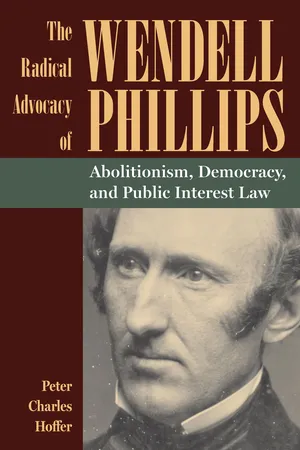
Examining the life of an early advocate of the legal rights of Black Americans
In this brisk, engaging exploration of 19th-century radical reformer and abolitionist Wendell Phillips, Peter Charles Hoffer makes the case that Phillips deserves credit as the nation's first public interest lawyer, someone who led the antebellum crusade against slavery and championed First Amendment rights and equality for all Americans, including Black people and women.
As a young lawyer, bored and working at a languishing practice, Phillips nonetheless believed that the law would serve as the basis for meaningful social change, including the abolishment of slavery. While many believed the US Constitution was a virtually faultless, foundational document for governance, Phillips viewed it as deeply racist, proslavery, and, therefore, in contradiction to the Declaration of Independence. Unsurprisingly, many of Phillips's ideas were viewed as controversial and unpopular at the time, even with other abolitionists. He frequently disagreed with more conservative politicians, including Abraham Lincoln.
But beyond merely criticizing the Constitution, Phillips subscribed to a "democratic positivist" belief, which contends that law is the central component of a strong democracy and that law can and should be changed by the will of the people. Thus, he believed it was critical to change public opinion on issues like slavery, which in turn would help change laws that legalized the institution. Throughout his life, he used his impressive skills as an orator to raise awareness to the horrors of enslavement, appealed to Americans' consciences, and directed them to act through voting and lawmaking.
Democratic positivist approaches like his have continued to be used by lawyers to influence social reforms ranging from the civil rights movement of the 1960s to advocacy for unhoused people to abolishing America's carceral state, and Hoffer persuasively argues that Phillips's influence has been long ranging and is still recognizable in contemporary America's political landscape.