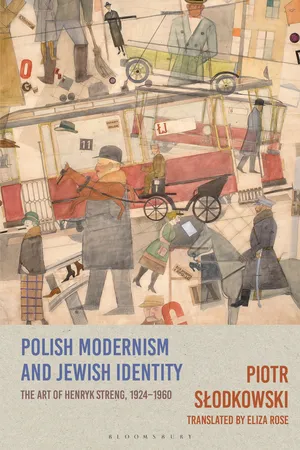
Modernist painter, socialist realist, Holocaust survivor, and student of the Parisian Avant Garde, Jewish-Polish artist Henryk Streng was extraordinary for his aesthetic innovation during the two major traumas of 20th-century European history, the Holocaust and Stalinism. Yet his legacy in the development of European modernism is rarely acknowledged. In this book, inspired by the 2021 exhibition at the Museum of Modern Art in Warsaw, Piotr Slodkowski demonstrates that the work of Streng disrupts established notions of 20th-century Polish art, connecting local Polish art history with wider 20th-century artistic movements and styles.
Traversing the 1920s Académie Moderne, hubs of creativity in interwar Poland, Nazi concentration camps, and the Polish People's Republic under Soviet influence, this book reveals the changing artistic phenomena of Poland between the 1920s and 1950s, illustrating how Streng drew on his Jewish-Polish identity and the legacy of genocide in his work. Rather than deferring to the French Avant Garde, Slodkowski sheds light on regional expressions of modernism and emphasises the complexity of identity and creativity in 20th-century Poland. In doing so, this book brings Streng out of the shadows and into wider considerations of modernist European art and its development.
eBook - PDF
Polish Modernism and Jewish Identity
The Art of Henryk Streng, 1924-1960
- 273 pages
- English
- PDF
- Available on iOS & Android
eBook - PDF
About this book
Information
Topic
ArtSubtopic
History of Modern ArtTable of contents
- Cover
- Halftitle page
- Title page
- Copyright page
- Dedication
- CONTENTS
- ILLUSTRATIONS
- ACKNOWLEDGMENTS
- Introduction
- PART 1 Modernism
- 1 So far, so near: Streng’s regional modernism
- 2 Where is modernism? From centers and peripheries to network of localities
- PART 2 Socially engaged art
- 3 Factorealism in fragments
- 4 Barricades and the margins of socialist realism in Poland
- PART 3 Identity
- 5 Life and work in wartime
- 6 Streng/Wlodarski’s postwar identity
- Conclusion Back to the artists and their art
- NOTES
- BIBLIOGRAPHY
- INDEX
Trusted by 375,005 students
Access to over 1.5 million titles for a fair monthly price.
Study more efficiently using our study tools.
Frequently asked questions
Yes, you can cancel anytime from the Subscription tab in your account settings on the Perlego website. Your subscription will stay active until the end of your current billing period. Learn how to cancel your subscription
No, books cannot be downloaded as external files, such as PDFs, for use outside of Perlego. However, you can download books within the Perlego app for offline reading on mobile or tablet. Learn how to download books offline
Perlego offers two plans: Essential and Complete
- Essential is ideal for learners and professionals who enjoy exploring a wide range of subjects. Access the Essential Library with 800,000+ trusted titles and best-sellers across business, personal growth, and the humanities. Includes unlimited reading time and Standard Read Aloud voice.
- Complete: Perfect for advanced learners and researchers needing full, unrestricted access. Unlock 1.5M+ books across hundreds of subjects, including academic and specialized titles. The Complete Plan also includes advanced features like Premium Read Aloud and Research Assistant.
We are an online textbook subscription service, where you can get access to an entire online library for less than the price of a single book per month. With over 1.5 million books across 990+ topics, we’ve got you covered! Learn about our mission
Look out for the read-aloud symbol on your next book to see if you can listen to it. The read-aloud tool reads text aloud for you, highlighting the text as it is being read. You can pause it, speed it up and slow it down. Learn more about Read Aloud
Yes! You can use the Perlego app on both iOS and Android devices to read anytime, anywhere — even offline. Perfect for commutes or when you’re on the go.
Please note we cannot support devices running on iOS 13 and Android 7 or earlier. Learn more about using the app
Please note we cannot support devices running on iOS 13 and Android 7 or earlier. Learn more about using the app
Yes, you can access Polish Modernism and Jewish Identity by Piotr Slodkowski, Eliza Rose in PDF and/or ePUB format, as well as other popular books in Art & History of Modern Art. We have over 1.5 million books available in our catalogue for you to explore.