- English
- ePUB (mobile friendly)
- Available on iOS & Android
About this book
"Maximum Likelihood Estimation. . . provides a useful introduction. . . it is clear and easy to follow with applications and graphs. . . . I consider this a very useful book. . . . well-written, with a wealth of explanation. . ."
--Dougal Hutchison in Educational Research
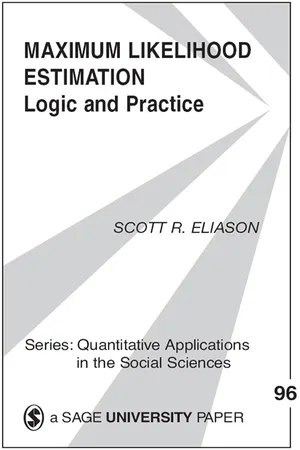
Eliason reveals to the reader the underlying logic and practice of maximum likelihood (ML) estimation by providing a general modeling framework that utilizes the tools of ML methods. This framework offers readers a flexible modeling strategy since it accommodates cases from the simplest linear models (such as the normal error regression model) to the most complex nonlinear models that link a system of endogenous and exogenous variables with non-normal distributions. Using examples to illustrate the techniques of finding ML estimators and estimates, Eliason discusses what properties are desirable in an estimator, basic techniques for finding maximum likelihood solutions, the general form of the covariance matrix for ML estimates, the sampling distribution of ML estimators; the use of ML in the normal as well as other distributions, and some useful illustrations of likelihoods.
Frequently asked questions
- Essential is ideal for learners and professionals who enjoy exploring a wide range of subjects. Access the Essential Library with 800,000+ trusted titles and best-sellers across business, personal growth, and the humanities. Includes unlimited reading time and Standard Read Aloud voice.
- Complete: Perfect for advanced learners and researchers needing full, unrestricted access. Unlock 1.4M+ books across hundreds of subjects, including academic and specialized titles. The Complete Plan also includes advanced features like Premium Read Aloud and Research Assistant.
Please note we cannot support devices running on iOS 13 and Android 7 or earlier. Learn more about using the app.
Information
Table of contents
- Cover Page
- Title Page
- Copyright Page
- Contents
- Seríes Editor’s Introduction
- 1. Introduction: The Logic of Maximum Likelihood
- 2. A General Modeling Framework Using Maximum Likelihood Methods
- 3. An Introduction to Basic Estimation Techniques
- 4. Further Empirical Examples
- 5. Additional Likelihoods
- 6. Conclusions
- Appendix: Gauss Code for Some of the Models in the Monograph
- Notes
- References
- About the Author