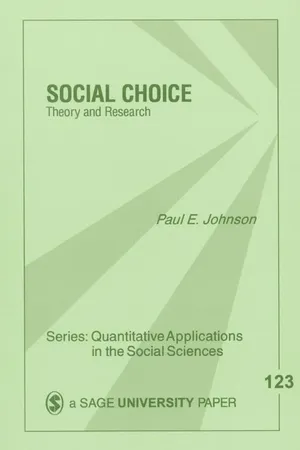
Author Paul E. Johnson introduces researchers to the key questions, concepts, terminology, methods, and results of social choice theory, a method of aggregating individualÆs preferences into societal preferences (such as voting). By presenting technical details from the ôground up,ö Johnson first introduces readers to the effects that decision-making procedures have on social choice. He next explains the idea of a social preference function, a rule that is used to take into account individuals, preferences when creating social ordering. He explores the basics and implications of ArrowÆs possibility theorem and the implications and applications of the uni-dimensional spatial model. Social Choice: Theory and Research concludes with an investigation of the multidimensional spatial model and an exploration of the instability of majority rule, including a discussion of chaos theory. Students in political theory, public choice, and public finance will find Social Choice: Theory and Research a comprehensible introduction to social choice theory. Researchers interested in decision-making difficulties in government, international organizations, and corporations will find this a handy reference for their studies.
- 121 pages
- English
- PDF
- Available on iOS & Android
eBook - PDF
About this book
Information
Table of contents
- Cover
- Contents
- Series Editor’s Introduction
- Acknowledgments
- Preface
- Chapter 1 - What is Social Choice Theory
- The Voter’s Paradox
- The Big Picture
- An Outline of This Book
- Chapter 2 - Fundamental Terminology: Discrete Social Choice
- Chapter 3 - Arrow’s Theorem
- The Social Preference Function
- Arrow’s Possibility Theorem
- The Meaning of Arrow’s Theorem
- Chapter 4 - Fundamental Terminology: Continuous Sets of Alternatives
- The Euclidean Spatial Model
- Utility Functions
- Continuity and Utility Representations on the Continuum
- Convexity and Single-Peakedness
- Chapter 5 - The Unidimensional Spatial Model
- The Importance of Single-Peaked Preferences
- The Median Voter Theorem
- Reversion Points and Take-It-or-Leave-It Offers
- Unraveling in Democratically Governed Groups
- Chapter 6 - The Multidimensional Spatial Model
- The Importance of Convexity
- Stability Analysis: Majority Rule in Several Dimensions
- The Chaos Theorems
- Addressing the Disequilibrium Problem
- Structure-Induced Equilibrium
- Behavioral Sources of Stability
- Chapter 7 - Conclusion: Looking Backward and Forward
- References
- About the Author
Trusted by 375,005 students
Access to over 1.5 million titles for a fair monthly price.
Study more efficiently using our study tools.
Frequently asked questions
Yes, you can cancel anytime from the Subscription tab in your account settings on the Perlego website. Your subscription will stay active until the end of your current billing period. Learn how to cancel your subscription
No, books cannot be downloaded as external files, such as PDFs, for use outside of Perlego. However, you can download books within the Perlego app for offline reading on mobile or tablet. Learn how to download books offline
Perlego offers two plans: Essential and Complete
- Essential is ideal for learners and professionals who enjoy exploring a wide range of subjects. Access the Essential Library with 800,000+ trusted titles and best-sellers across business, personal growth, and the humanities. Includes unlimited reading time and Standard Read Aloud voice.
- Complete: Perfect for advanced learners and researchers needing full, unrestricted access. Unlock 1.5M+ books across hundreds of subjects, including academic and specialized titles. The Complete Plan also includes advanced features like Premium Read Aloud and Research Assistant.
We are an online textbook subscription service, where you can get access to an entire online library for less than the price of a single book per month. With over 1.5 million books across 990+ topics, we’ve got you covered! Learn about our mission
Look out for the read-aloud symbol on your next book to see if you can listen to it. The read-aloud tool reads text aloud for you, highlighting the text as it is being read. You can pause it, speed it up and slow it down. Learn more about Read Aloud
Yes! You can use the Perlego app on both iOS and Android devices to read anytime, anywhere — even offline. Perfect for commutes or when you’re on the go.
Please note we cannot support devices running on iOS 13 and Android 7 or earlier. Learn more about using the app
Please note we cannot support devices running on iOS 13 and Android 7 or earlier. Learn more about using the app
Yes, you can access Social Choice by Paul E Johnson in PDF and/or ePUB format, as well as other popular books in Social Sciences & Social Science Research & Methodology. We have over 1.5 million books available in our catalogue for you to explore.