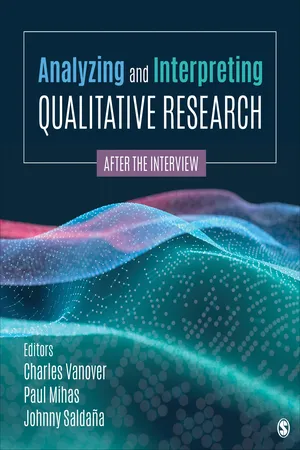
This text provides comprehensive coverage of the key methods for analyzing, interpreting, and writing up qualitative research in a single volume, and drawing on the expertise of major names in the field. Covering all the steps in the process of analyzing, interpreting, and presenting findings in qualitative research, the authors utilize a consistent chapter structure that provides novice and seasoned researchers with pragmatic, "how-to" strategies. Each chapter introduces the method; uses one of the authors? own research projects as a case study of the method described; shows how the specific analytic method can be used in other types of studies; and concludes with questions and activities to prompt class discussion or personal study.
eBook - ePub
Analyzing and Interpreting Qualitative Research
After the Interview
- English
- ePUB (mobile friendly)
- Available on iOS & Android
eBook - ePub
Analyzing and Interpreting Qualitative Research
After the Interview
About this book
Information
Table of contents
- Cover
- Acknowledgements
- Title Page
- Copyright Page
- Contents
- Acknowledgments
- About the Editors
- Introduction
- Section 1 Data and Conceptual Options
- As a Qualitative Study Unfolds: Shifts in Design and Analysis
- Using Qualitative Data Analysis Software to Manage the Research Process
- After Someone Elses Interview
- Section 2 Interview Transcription Strategies
- Transcription as a Form of Qualitative Inquiry
- Theories and Practices of Transcription from Discourse Analysis
- Voice to Text: Automating Transcription
- Section 3 Strategies for Coding and Categorizing Data
- Coding System Design and Management
- Deductive and Inductive Approaches to Qualitative Data Analysis
- Coding, Categorizing, and Theming the Data: A Reflexive Search for Meaning
- Oral Coding: An Alternative Way to Make Sense of Interview Data
- Mapping Trajectories: Analyzing Focus Group Data Rhizomatically
- Analyzing and Coding Interviews and Focus Groups Considering Cross-Cultural and Cross-Language Data
- Section 4 Reflection and Analytic Memoing Strategies
- On Being a Researcher-Participant: Challenges With the Iterative Process of Data Production, Analysis, and (Re)Production
- Memo Writing Strategies: Analyzing the Parts and the Whole
- Critical Analytic Memoing*
- Section 5 Interpretive Strategies
- Listening Deeply: Indexing Research Conversations in a Narrative Inquiry
- Emergent Analysis: Strategies for Making Sense of an Evolving Longitudinal Study
- Making Claims Using Qualitative Data
- Section 6 Arts-Based Practices
- Dramatizing Interviews
- What Makes an Effective Teacher? Revealing Good Teaching Practice Through Interview Poetic Transcription
- Embedding Critical, Creative, and Contemplative Data Analysis in Interview Studies
- Follow the Headlights: On Comics-Based Data Analysis
- Section 7 Writing-Up Practices
- Turning Transcripts Into Stories
- Writing for a Broad Audience: Concept Papers, Blogs, and OpEds
- Sophies Choices: The Social Act of Publishing a Qualitative Study
- Conclusion
- About the Contributors
- Index
Trusted by 375,005 students
Access to over 1.5 million titles for a fair monthly price.
Study more efficiently using our study tools.
Frequently asked questions
Yes, you can cancel anytime from the Subscription tab in your account settings on the Perlego website. Your subscription will stay active until the end of your current billing period. Learn how to cancel your subscription
No, books cannot be downloaded as external files, such as PDFs, for use outside of Perlego. However, you can download books within the Perlego app for offline reading on mobile or tablet. Learn how to download books offline
Perlego offers two plans: Essential and Complete
- Essential is ideal for learners and professionals who enjoy exploring a wide range of subjects. Access the Essential Library with 800,000+ trusted titles and best-sellers across business, personal growth, and the humanities. Includes unlimited reading time and Standard Read Aloud voice.
- Complete: Perfect for advanced learners and researchers needing full, unrestricted access. Unlock 1.5M+ books across hundreds of subjects, including academic and specialized titles. The Complete Plan also includes advanced features like Premium Read Aloud and Research Assistant.
We are an online textbook subscription service, where you can get access to an entire online library for less than the price of a single book per month. With over 1.5 million books across 990+ topics, we’ve got you covered! Learn about our mission
Look out for the read-aloud symbol on your next book to see if you can listen to it. The read-aloud tool reads text aloud for you, highlighting the text as it is being read. You can pause it, speed it up and slow it down. Learn more about Read Aloud
Yes! You can use the Perlego app on both iOS and Android devices to read anytime, anywhere — even offline. Perfect for commutes or when you’re on the go.
Please note we cannot support devices running on iOS 13 and Android 7 or earlier. Learn more about using the app
Please note we cannot support devices running on iOS 13 and Android 7 or earlier. Learn more about using the app
Yes, you can access Analyzing and Interpreting Qualitative Research by Charles Vanover,Paul Mihas,Johnny Saldana in PDF and/or ePUB format, as well as other popular books in Social Sciences & Educational Psychology. We have over 1.5 million books available in our catalogue for you to explore.