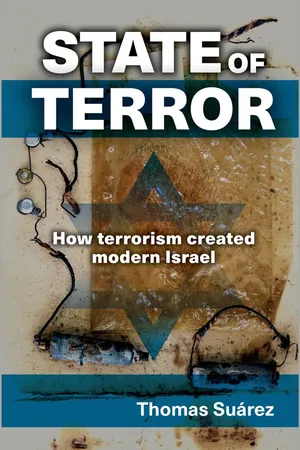
From 1940 on, when Palestine was still ruled by the British, violence and terror were used by Zionist terror groups to deny the rights of the indigenous Palestinians to the land they had lived in for generations, and to attack anyone, including the British, who tried to uphold those rights. It is uncomfortable to read and shocking in its implications, providing evidence for a case that has been denied for 60 years or more by the Israelis. Suarez takes the story beyond the establishment of Israel in 1948 and shows how in first decade of its existence, the new Israel government, angered by the fact that Palestinian Arabs still remained in the state, continued to use terror in an attempt to make the remaining Arab inhabitants leave their land.
eBook - ePub
State of Terror
About this book
Information
Edition
0Table of contents
- Cover Page
- Title Page
- Copyright Page
- Contents
- Dedtcation Page
- Acknowledgments
- Illustration credits
- Introduction
- Notes
- Part I Other People’s Lands
- 1. The Third Temple
- 2. Zionism and the British Mandate to 1938
- 3. While the War Raged, 1939-1944
- Part II The Fall—and Rise—of Fascism
- 4. Allied Victory, 1945
- 5. Race for Fanaticism, 1946
- 6. ‘A Besieged Garrison’, 1947
- Part III ‘Only a Beachhead’
- 7. Partition, the ‘temporary expedient’, 1947-1948
- 8. Israel sans frontières
- 9. Postscript: Segue to Today
- Bibliography
- Sources used at The National Archives (Kew)
- End Notes
- Index
Trusted by 375,005 students
Access to over 1.5 million titles for a fair monthly price.
Study more efficiently using our study tools.