- 138 pages
- English
- PDF
- Available on iOS & Android
eBook - PDF
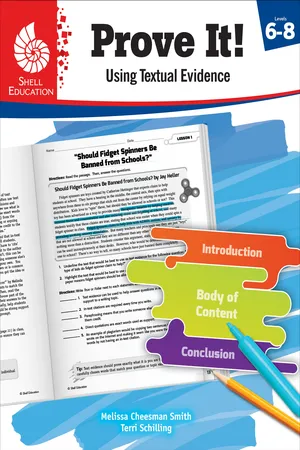
Prove It! Using Textual Evidence, Levels 6-8
About this book
Knowing how to cite textual evidence is a key component in reading and writing in education today. This resource equips teachers with the strategies they need to teach students how to cite and annotate textual evidence when reading and writing. Secondary school students will learn how to find evidence to support their opinions, incorporate that evidence in their writing, and accurately cite their sources. The ten lessons include proper MLA formatting, paraphrasing, using block quotation, creating a bibliography, the use of credible sources, avoiding plagiarism, and more. Students will apply what they've learned through twenty practice exercises. Citing textual evidence powerfully strengthens students' writing, develops analytical thinking and logic, and readies students for college and career with lessons that are aligned to McREL, TESOL, and WIDA standards.
Information
Topic
EducationSubtopic
Education Teaching MethodsTable of contents
- Cover
- Credits
- Page 3 - Table of Contents
- Page 4 - From the Authors
- Page 5 - Foreword
- Page 7 - Using Textual Evidence and Citations
- Page 10 - How to Use this Book
- Page 11 - Standards Correlations
- Page 16 - Lesson 1: Introduction to Textual Evidence
- Page 21 - Lesson 2: Citing with Direct Quotations
- Page 24 - Lesson 3: Citing with Block Quotations
- Page 27 - Lesson 4: Citing with Paraphrasing
- Page 30 - Lesson 5: Citing with Poetry
- Page 33 - Practice 1: Author’s Purpose
- Page 37 - Practice 2: Text Structure
- Page 41 - Practice 3: Main Idea
- Page 45 - Practice 4: Identifying Literary Devices
- Page 49 - Practice 5: Compare and Contrast
- Page 53 - Practice 6: Synthesizing and Summarizing
- Page 57 - Practice 7: Making Inferences.
- Page 61 - Practice 8: Identifying Key Details
- Page 65 - Practice 9: Asking Questions
- Page 69 - Practice 10: Compare and Contrast
- Page 75 - Lesson 6: Using Credible andReliable Sources
- Page 78 - Lesson 7: Supporting a Claim
- Page 81 - Lesson 8: Organizing Evidence
- Page 84 - Lesson 9: Writing an Analysis
- Page 87 - Lesson 10: Creating a Bibliography
- Page 90 - Writing Prompt 1: Description Text Structure
- Page 93 - Writing Prompt 2: Compare-and-Contrast Text Structure
- Page 96 - Writing Prompt 3: Cause-and-Effect Text Structure
- Page 99 - Writing Prompt 4: Cause-and-Effect Text Structure
- Page 102 - Writing Prompt 5: Sequence Text Structure
- Page 105 - Writing Prompt 6: Description Text Structure
- Page 108 - Writing Prompt 7: Description Text Structure.
- Page 111 - Writing Prompt 8: Classification Text Structure
- Page 114 - Writing Prompt 9: Problem-and-Solution Text Structure
- Page 117 - Writing Prompt 10: Compare-and-Contrast Text Structure
- Page 122 - Appendix A: Answer Key
- Page 127 - Appendix B: Additional Resources
- Page 136 - Appendix C: Contents of the Digital Resources
- Page 136 - Appendix D: References Cited
- Thank You Page
Trusted by 375,005 students
Access to over 1.5 million titles for a fair monthly price.
Study more efficiently using our study tools.
Frequently asked questions
Yes, you can cancel anytime from the Subscription tab in your account settings on the Perlego website. Your subscription will stay active until the end of your current billing period. Learn how to cancel your subscription
No, books cannot be downloaded as external files, such as PDFs, for use outside of Perlego. However, you can download books within the Perlego app for offline reading on mobile or tablet. Learn how to download books offline
Perlego offers two plans: Essential and Complete
- Essential is ideal for learners and professionals who enjoy exploring a wide range of subjects. Access the Essential Library with 800,000+ trusted titles and best-sellers across business, personal growth, and the humanities. Includes unlimited reading time and Standard Read Aloud voice.
- Complete: Perfect for advanced learners and researchers needing full, unrestricted access. Unlock 1.5M+ books across hundreds of subjects, including academic and specialized titles. The Complete Plan also includes advanced features like Premium Read Aloud and Research Assistant.
We are an online textbook subscription service, where you can get access to an entire online library for less than the price of a single book per month. With over 1.5 million books across 990+ topics, we’ve got you covered! Learn about our mission
Look out for the read-aloud symbol on your next book to see if you can listen to it. The read-aloud tool reads text aloud for you, highlighting the text as it is being read. You can pause it, speed it up and slow it down. Learn more about Read Aloud
Yes! You can use the Perlego app on both iOS and Android devices to read anytime, anywhere — even offline. Perfect for commutes or when you’re on the go.
Please note we cannot support devices running on iOS 13 and Android 7 or earlier. Learn more about using the app
Please note we cannot support devices running on iOS 13 and Android 7 or earlier. Learn more about using the app
Yes, you can access Prove It! Using Textual Evidence, Levels 6-8 by Terri Schilling,Melissa Cheesman Smith in PDF and/or ePUB format, as well as other popular books in Education & Education Teaching Methods. We have over 1.5 million books available in our catalogue for you to explore.