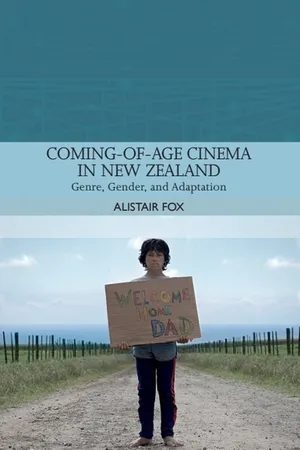
This is the first book to investigate the coming-of-age genre as a significant phenomenon in New Zealand's national cinema, tracing its development and elucidating its role in cultural change. With chapters on landmark films like An Angel at My Table, Heavenly Creatures, Once Were Warriors and Boy, this book explores the influence of the French New Wave and European art cinema, and examines the dialogue between national cinema and a nation's literature. Looking at the characteristics of an indigenous "Fourth Cinema," as well as different perspectives on gendered and sexual identities, Coming-of-Age Cinema in New Zealand considers the evidence that these films provide of significant cultural shifts that have taken place or are in the process of taking place as New Zealanders' discover their emerging national identity.
- 260 pages
- English
- PDF
- Available on iOS & Android
eBook - PDF
About this book
Information
Subtopic
Film & VideoTable of contents
- Cover
- Title Page
- Copyright
- Contents
- Illustrations
- Preface
- Traditions in World Cinema
- Part 1 The Coming-of-age Genre and National Cinema
- 1. The Coming-of-age Film as a Genre: Attributes, Evolution, and Functions
- 2. New Zealand Coming-of-age Films: Distinctive Characteristics and Thematic Preoccupations
- Part 2 The New Zealand New Wave: 1976-89
- 3. The Formation of a Budding Man Alone: The God Boy (Murray Reece, 1976)
- 4. An Angry Young Man Seeks to Justify Himself: Sleeping Dogs (Roger Donaldson, 1977)
- 5. An Immigrant Filmmaker Substitutes an Alternative Vision of Adolescence: The Scarecrow
- 6. Art-cinema, Cultural Dislocation, and the Entry into Puberty: Vigil (Vincent Ward, 1984)
- 7. A Maori Girl Watches, Listens, and Learns - Coming of Age from an Indigenous Viewpoint
- Part 3 The Second Wave of the 1990s
- 8. Creativity as a Haven: An Angel at My Table (Jane Campion, 1990)
- 9. Desperation Turned Outwards: Heavenly Creatures (Peter Jackson, 1994)
- 10. Confronting Domestic Violence and Familial Abuse: Once Were Warriors (Lee Tamahori, 1994)
- Part 4 Preoccupations of the New Millennium
- 11. An Adolescent Girl Experiments with Sexuality: Rain (Christine Jeffs, 2001)
- 12. Asserting Feminist Claims within Maori Culture: Whale Rider (Niki Caro, 2002)
- 13. Family Secrets and Their Destructive Consequences: In My Father’s Den (Brad McGann, 2004)
- 14. A Gay Boy Comes to Terms with His Sexuality: 50 Ways of Saying Fabulous (Stewart Main, 2005)
- Part 5 Perspectives on Maori Culture since 2010
- 15. Parental Abandonment and the Trauma of Loss: Boy (Taika Waititi, 2010)
- 16. A Maori Boy Contests the Old Patriarchal Order: Mahana (Lee Tamahori, 2016)
- 17. Delinquency and Bicultural Relations: Hunt for the Wilderpeople (Taika Waititi, 2016)
- Conclusion
- Bibliography
- Index
Trusted by 375,005 students
Access to over 1.5 million titles for a fair monthly price.
Study more efficiently using our study tools.
Frequently asked questions
Yes, you can cancel anytime from the Subscription tab in your account settings on the Perlego website. Your subscription will stay active until the end of your current billing period. Learn how to cancel your subscription
No, books cannot be downloaded as external files, such as PDFs, for use outside of Perlego. However, you can download books within the Perlego app for offline reading on mobile or tablet. Learn how to download books offline
Perlego offers two plans: Essential and Complete
- Essential is ideal for learners and professionals who enjoy exploring a wide range of subjects. Access the Essential Library with 800,000+ trusted titles and best-sellers across business, personal growth, and the humanities. Includes unlimited reading time and Standard Read Aloud voice.
- Complete: Perfect for advanced learners and researchers needing full, unrestricted access. Unlock 1.5M+ books across hundreds of subjects, including academic and specialized titles. The Complete Plan also includes advanced features like Premium Read Aloud and Research Assistant.
We are an online textbook subscription service, where you can get access to an entire online library for less than the price of a single book per month. With over 1.5 million books across 990+ topics, we’ve got you covered! Learn about our mission
Look out for the read-aloud symbol on your next book to see if you can listen to it. The read-aloud tool reads text aloud for you, highlighting the text as it is being read. You can pause it, speed it up and slow it down. Learn more about Read Aloud
Yes! You can use the Perlego app on both iOS and Android devices to read anytime, anywhere — even offline. Perfect for commutes or when you’re on the go.
Please note we cannot support devices running on iOS 13 and Android 7 or earlier. Learn more about using the app
Please note we cannot support devices running on iOS 13 and Android 7 or earlier. Learn more about using the app
Yes, you can access Coming-of-Age Cinema in New Zealand by Alistair Fox in PDF and/or ePUB format, as well as other popular books in Media & Performing Arts & Film & Video. We have over 1.5 million books available in our catalogue for you to explore.