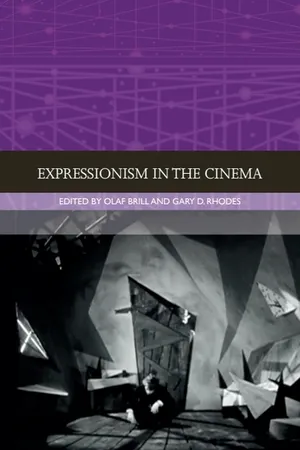
One of the most visually striking traditions in cinema, for too long Expressionism has been a neglected critical category of research in film history and aesthetics. The fifteen essays in this anthology remedies this by revisiting key German films like The Cabinet of Dr. Caligari (1920) and Nosferatu (1922), and also provide original critical research into more obscure titles like Nerven (1919) and The Phantom Carriage (1921), films that were produced in the silent and early sound era in countries ranging from France, Sweden and Hungary, to the United States and Mexico. An innovative and wide-ranging collection, Expressionism in the Cinema re-canonizes the classical Expressionist aesthetic, extending the critical and historical discussion beyond pre-existing scholarship into comparative and interdisciplinary areas of film research that reach across national boundaries.
- 331 pages
- English
- PDF
- Available on iOS & Android
eBook - PDF
Expressionism in the Cinema
About this book
Information
Subtopic
Film & VideoTable of contents
- EXPRESSIONISM IN THE CINEMA
- Copyright
- Contents
- Illustrations
- Contributors
- TRADITIONS IN WORLD CINEMA
- Introduction
- 1. Expressionist Cinema— Style and Design in Film History
- 2. Of Nerves and Men: Postwar Delusion and Robert Reinert’s Nerven
- 3. Franjo Ledic: A Forgotten Pioneer of German Expressionism
- 4. Expressionist Film and Gender: Genuine, A Tale of a Vampire (1920)
- 5. “The Secrets of Nature and Its Unifying Principles”: Nosferatu (1922) and Jakob von Uexküll on Umwelt
- 6. Raskolnikow (1923): Russian Literature as Impetus for German Expressionism
- 7. The Austrian Connection: The Frame Story and Insanity in Paul Czinner’s Inferno (1919) and Fritz Freisler’s The Mandarin (1918)
- 8. “The reawakening of French cinema”:
- 9. Here Among the Dead: The Phantom Carriage (1921) and the Cinema of the Occulted Taboo
- 10. Drakula halála (1921): The Cinema’s First Dracula
- 11. Le Brasier ardent (1923): Ivan Mosjoukine’s clin d’oeil to German xpressionism
- 12. Nietzsche’s Fingerprints on The Hands of Orlac (1924)
- 13. “True, Nervous”: American Expressionist Cinema and the Destabilized Male
- 14. Dos monjes (1934) and the Tortured Search for Truth
- 15. Maya Deren in Person in Expressionism
- Index of Names
- Index of Film Titles
Trusted by 375,005 students
Access to over 1.5 million titles for a fair monthly price.
Study more efficiently using our study tools.
Frequently asked questions
Yes, you can cancel anytime from the Subscription tab in your account settings on the Perlego website. Your subscription will stay active until the end of your current billing period. Learn how to cancel your subscription
No, books cannot be downloaded as external files, such as PDFs, for use outside of Perlego. However, you can download books within the Perlego app for offline reading on mobile or tablet. Learn how to download books offline
Perlego offers two plans: Essential and Complete
- Essential is ideal for learners and professionals who enjoy exploring a wide range of subjects. Access the Essential Library with 800,000+ trusted titles and best-sellers across business, personal growth, and the humanities. Includes unlimited reading time and Standard Read Aloud voice.
- Complete: Perfect for advanced learners and researchers needing full, unrestricted access. Unlock 1.5M+ books across hundreds of subjects, including academic and specialized titles. The Complete Plan also includes advanced features like Premium Read Aloud and Research Assistant.
We are an online textbook subscription service, where you can get access to an entire online library for less than the price of a single book per month. With over 1.5 million books across 990+ topics, we’ve got you covered! Learn about our mission
Look out for the read-aloud symbol on your next book to see if you can listen to it. The read-aloud tool reads text aloud for you, highlighting the text as it is being read. You can pause it, speed it up and slow it down. Learn more about Read Aloud
Yes! You can use the Perlego app on both iOS and Android devices to read anytime, anywhere — even offline. Perfect for commutes or when you’re on the go.
Please note we cannot support devices running on iOS 13 and Android 7 or earlier. Learn more about using the app
Please note we cannot support devices running on iOS 13 and Android 7 or earlier. Learn more about using the app
Yes, you can access Expressionism in the Cinema by Olaf Brill,Gary D. Rhodes in PDF and/or ePUB format, as well as other popular books in Media & Performing Arts & Film & Video. We have over 1.5 million books available in our catalogue for you to explore.