Promote scientific learning and encourage students to become actively engaged scientists with exciting lab investigations, focusing on processes and results. Supporting core concepts of STEM instruction and improving conceptual knowledge that is necessary for college and career, students in grades 6-8 will delve into the inquiry process and scientific analysis. Students also record and analyze steps, processes, and results through writing and drawing in observation notebooks.
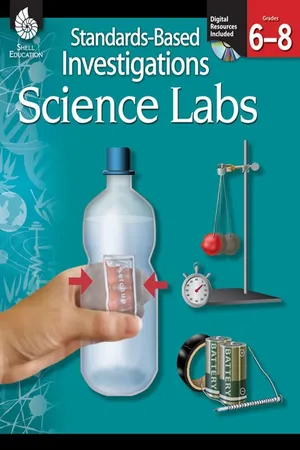
eBook - PDF
Standards-Based Investigations
Science Labs Grades 6-8
- 194 pages
- English
- PDF
- Available on iOS & Android
eBook - PDF
Standards-Based Investigations
Science Labs Grades 6-8
About this book
Table of contents
- Cover
- Credits
- Page 3 - Table of Contents
- Page 4 - Table of Contents (cont.)
- Page 5 - Introduction and Research Base
- Page 6 - Water Cycle
- Page 12 - Rocks: What Are They Good For?
- Page 14 - How Is Rain Made?
- Page 15 - How Is the Sun Like Baseball?
- Page 19 - What Do Greenhouse Gases Do?
- Page 21 - How Can I Build a Water Molecule?
- Page 24 - How Does Water Stick Together?
- Page 28 - How Is Water the “Universal Solvent”?
- Page 30 - How Does Water Move?
- Page 32 - How Does Floating Work?
- Page 34 - Geology
- Page 39 - How Is Earth Like a Book?
- Page 42 - What Makes Soils Different?
- Page 44 - How Can I Eat Seattle?
- Page 47 - How Are Igneous Rocks Formed?
- Page 48 - What Can I Find by Digging Up Climatasaurs?
- Page 50 - Astronomy
- Page 55 - What Makes Planets Bulge?
- Page 56 - What Causes an Eclipse?
- Page 59 - How Is a Star Put Together?
- Page 63 - What Is a Comet Made Of?
- Page 65 - Heredity
- Page 69 - How Do Seeds Travel?
- Page 71 - How Big Should My Dog House Be?
- Page 73 - How Is DNA Put Together?
- Page 76 - Biology
- Page 82 - How Magnificent Is HOC?
- Page 85 - How Does an Arm Work?
- Page 87 - What Is Spit Good For?
- Page 89 - How Does the Inner Ear Work?
- Page 90 - How Does the Eye Work?
- Page 92 - What Are Thumbs Good For?
- Page 93 - How Does Streamlining Work?
- Page 95 - Ecology
- Page 102 - What Gives the Zebra Its Speed?
- Page 104 - How Do Consumers Trade Off?
- Page 106 - How Is Sunlight Passed Around?
- Page 109 - How Do Ecosystems Recycle?
- Page 112 - Matter
- Page 118 - How Do Smells Travel?
- Page 119 - How Does a Mass Spectrometer Work?
- Page 121 - How Are Crystals Created?
- Page 123 - Why Do Crystals Have Regular Shapes?
- Page 124 - How Do Gas Particles Move?
- Page 126 - What Is Air Pressure?
- Page 128 - How Can I Separate Shavings from Sand?
- Page 130 - What Pushes the Water Out?
- Page 131 - Energy
- Page 137 - How Does an Electrophorus Work?
- Page 139 - How Does a Turbine Work?
- Page 141 - How Does an Electroscope Work?
- Page 142 - How Can I Make a Morse Code Tapper?
- Page 144 - How Does a Dimmer Switch Work?
- Page 146 - How Can I Make a Battery?
- Page 148 - What Disturbs the Flame?
- Page 149 - What Do Sound Waves Look Like?
- Page 150 - How Does Sound Travel?
- Page 152 - What Changes a Sound’s Pitch?
- Page 154 - How Are Light and Heat Related?
- Page 156 - How Does a Camera Work?
- Page 157 - How Does Light Scatter?
- Page 159 - Forces and Motion
- Page 165 - What Do I Weigh on Jupiter?
- Page 167 - What Makes the Coil Move?
- Page 169 - How Can I Throw Without Touching?
- Page 170 - How Does the Door Chime Work?
- Page 172 - What Makes the Horse Prance?
- Page 174 - How Can a Balloon Inflate Without More Air?
- Page 176 - How Tall Can I Build It?
- Page 177 - What Stops the Water?
- Page 179 - What Makes an Object Float?
- Page 181 - How Can I Make a Sinker Float?
- Page 183 - Which Shapes Float?
- Page 184 - How Does a Submarine Work?
- Page 186 - How Does a Siphon Work?
- Page 188 - What Is Recoil?
- Page 189 - What Is Momentum?
- Page 190 - Why Do the Eggs Move Differently?
- Page 192 - References Cited
- Thank You Page
Trusted by 375,005 students
Access to over 1.5 million titles for a fair monthly price.
Study more efficiently using our study tools.