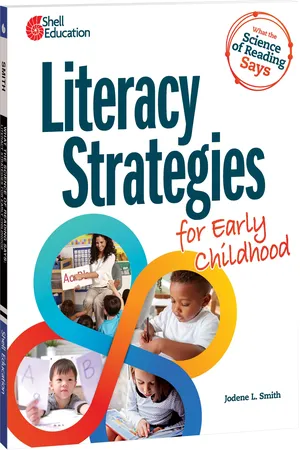
Bring the science of reading directly into the classroom! Developed for Grades PK-K, this resource provides teachers with exciting strategies to develop students’ foundational literacy skills. This book offers easy-to-use lessons and methods to give young learners practice with phonological awareness, letter recognition, comprehension, content knowledge, and emergent writing. With these research-based strategies, early childhood teachers can make reading and writing fun, meaningful, and effective! This book meets College and Career Readiness and other state standards.
eBook - PDF
What the Science of Reading Says
Literacy Strategies for Early Childhood
- 178 pages
- English
- PDF
- Available on iOS & Android
eBook - PDF
What the Science of Reading Says
Literacy Strategies for Early Childhood
About this book
Information
Topic
EducationSubtopic
Teaching LanguagesTable of contents
- Cover
- Title Page
- Copyright Page
- Page iii - Table of Contents
- Page iv - Table of Contents Cont
- Page 1 - Introduction
- Page 1 - What the Science of Reading Says
- Page 2 - The Science of Reading: Models of Reading
- Page 4 - The Science of Reading: Implications for Teaching
- Page 7 - Components of Literacy
- Page 10 - Factors That Contribute to Success in Reading and Writing
- Page 13 - Differentiation
- Page 15 - Cultural Relevance
- Page 17 - How to Use This Book
- Page 18 - Section I: Word Recognition
- Page 30 - What Is a Word?
- page 32 - Working with Words-Compound Words
- Page 38 - Silly Willy Rhyming Words
- Page 40 - Create New Nursery Rhymes
- Page 42 - Feel the Syllables
- Page 44 - Making Sandwiches with Onsets and Rimes
- Page 48 - Isolating Sounds with Movement
- Page 50 - Sound Boxes
- Page 54 - Introducing Letters and Sounds
- Page 56 - Alphabet Sound Chart
- Page 59 - Working with an Alphabet Arc
- Page 67 - Alphabet Sorts
- Page 78 - Blending with Cruising Cars
- Page 82 - igh-Frequency Word Match
- Page 84 - Section II: Reading Comprehension and Content Knowledge
- Page 95 - Using Text Sets for Wide and Extensive Reading
- Page 98 - Creating Concept Maps
- Page 100 - What I Know
- Page 102 - Shared Experience
- Page 104 - Explicit Vocabulary Word Instruction
- Page 108 - Incidental Vocabulary Word Instruction
- Page 111 - Shades of Meaning
- Page 113 - Many Ways to Say It
- Page 116 - Identifying Multiple-Meaning Words
- Page 118 - Picture Inference
- Page 121 - Figurative Language Awareness
- Page 123 - Teaching Concepts of Prin
- Page 125 - Informational Text Genre Study
- Page 129 - Section III: Writing
- Page 139 - Print-Rich Environment
- Page 141 - Multisensory Letter Formation Practice
- Page 143 - Name Writing
- Page 145 - Morning Message
- Page 147 - Picture Word Chart
- Page 149 - Experience, Talk, Write
- Page 151 - Journal Writing
- Page 155 - Predictable Sentences
- Page 158 - The Big Three
- Page 160 - References
- Page 170 - Digital Resources
- B
Trusted by 375,005 students
Access to over 1.5 million titles for a fair monthly price.
Study more efficiently using our study tools.
Frequently asked questions
Yes, you can cancel anytime from the Subscription tab in your account settings on the Perlego website. Your subscription will stay active until the end of your current billing period. Learn how to cancel your subscription
No, books cannot be downloaded as external files, such as PDFs, for use outside of Perlego. However, you can download books within the Perlego app for offline reading on mobile or tablet. Learn how to download books offline
Perlego offers two plans: Essential and Complete
- Essential is ideal for learners and professionals who enjoy exploring a wide range of subjects. Access the Essential Library with 800,000+ trusted titles and best-sellers across business, personal growth, and the humanities. Includes unlimited reading time and Standard Read Aloud voice.
- Complete: Perfect for advanced learners and researchers needing full, unrestricted access. Unlock 1.5M+ books across hundreds of subjects, including academic and specialized titles. The Complete Plan also includes advanced features like Premium Read Aloud and Research Assistant.
We are an online textbook subscription service, where you can get access to an entire online library for less than the price of a single book per month. With over 1.5 million books across 990+ topics, we’ve got you covered! Learn about our mission
Look out for the read-aloud symbol on your next book to see if you can listen to it. The read-aloud tool reads text aloud for you, highlighting the text as it is being read. You can pause it, speed it up and slow it down. Learn more about Read Aloud
Yes! You can use the Perlego app on both iOS and Android devices to read anytime, anywhere — even offline. Perfect for commutes or when you’re on the go.
Please note we cannot support devices running on iOS 13 and Android 7 or earlier. Learn more about using the app
Please note we cannot support devices running on iOS 13 and Android 7 or earlier. Learn more about using the app
Yes, you can access What the Science of Reading Says by Jodene Smith,Jodene Lynn Smith M.A.,Jodene Lynn Smith in PDF and/or ePUB format, as well as other popular books in Education & Teaching Languages. We have over 1.5 million books available in our catalogue for you to explore.