- 202 pages
- English
- PDF
- Available on iOS & Android
eBook - PDF
About this book
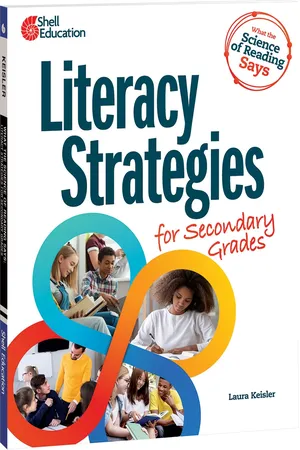
Bring the science of reading directly into the classroom! Developed for Grades 6-12, this resource offers teachers meaningful strategies to build students' reading and writing skills. This book provides easy-to-use methods and lessons to help older learners practice word recognition, reading comprehension and content knowledge, and writing. With these research-based strategies, middle and high school teachers can make reading and writing simple, engaging, and effective! This book meets College and Career Readiness and other state standards.
Information
Topic
EducationSubtopic
Teaching LanguagesTable of contents
- Cover
- Title page
- Copyright page
- Page iii - Table of Contents
- Page iv -Table of Contents
- Page 1 - Introduction
- Page 1 - What the Science of Reading Says
- Page 2 - The Science of Reading: Models of Reading
- page 4 - The Science of Reading: Implications for Teaching
- page 7 - Components of Literacy
- Page 10 - Factors That Contribute to Reading and Writing Success
- page 13 - Differentiation
- page 15 - Cultural Relevance
- page 17 - How to Use This Book
- page 19 - Section I: Word Recognition and Language Knowledge
- Page 24 - Whole-Class Choral Reading (WCCR)
- page 25 - Partner Reading
- page 28 - STRIVE Vocabulary Map
- page 32 - List-Group-Label
- Page 36 - Word Nerd
- page 40 - Sort It Out
- Page 44 - Word Matrix
- Page 48 - DISSECT
- Page 51 - Sentence Combining
- Page 53 - Grammar Rants
- Page 58 - Section II: Reading Comprehension and Content Knowledge
- Page 65 - Anticipation Guide
- Page 68 - Collaborative Concept Map
- Page 70 - Text Structure Analysis
- page 79 - Text Analysis Pyramid
- Annotation
- Page 82 - Annotate and Compare
- Page 84 - Annotate and Compare
- page 87 - Structured Annotation
- page 89 - Line-by-Line Reading
- page 91 - GRASP
- page 95 - Thinking at Right Angles
- page 99 - Question Journal
- Page 103 - Facts-Questions-Responses (FQR)
- Page 107 - Get the GIST
- Page 111 - Double Entry Journal .
- Page 115 - Reciprocal Teaching
- page 119 - Text Rendering
- page 124 - Section III: Writing
- page 133 - Genre Analysis
- Page 138 - EASE (Examine, Assess, Suggest, Envision)
- Page 142 - RAFT
- Page 145 - Expository Writing Frames
- page 148 - Scholarly Texts
- page 152 - Planning for Writing
- page 157 - Composing a Draft
- page 162 - R.A.C.E. Organizer
- page 166 - Revising Writing
- Page 171 - Editing Writing
- page 175 - Reading Response
- page 179 - Read, Reread, List, Compose (RRLC) .
- Page 183 - References
- Page 193 - Digital Resources
- BackCover
Trusted by 375,005 students
Access to over 1.5 million titles for a fair monthly price.
Study more efficiently using our study tools.
Frequently asked questions
Yes, you can cancel anytime from the Subscription tab in your account settings on the Perlego website. Your subscription will stay active until the end of your current billing period. Learn how to cancel your subscription
No, books cannot be downloaded as external files, such as PDFs, for use outside of Perlego. However, you can download books within the Perlego app for offline reading on mobile or tablet. Learn how to download books offline
Perlego offers two plans: Essential and Complete
- Essential is ideal for learners and professionals who enjoy exploring a wide range of subjects. Access the Essential Library with 800,000+ trusted titles and best-sellers across business, personal growth, and the humanities. Includes unlimited reading time and Standard Read Aloud voice.
- Complete: Perfect for advanced learners and researchers needing full, unrestricted access. Unlock 1.5M+ books across hundreds of subjects, including academic and specialized titles. The Complete Plan also includes advanced features like Premium Read Aloud and Research Assistant.
We are an online textbook subscription service, where you can get access to an entire online library for less than the price of a single book per month. With over 1.5 million books across 990+ topics, we’ve got you covered! Learn about our mission
Look out for the read-aloud symbol on your next book to see if you can listen to it. The read-aloud tool reads text aloud for you, highlighting the text as it is being read. You can pause it, speed it up and slow it down. Learn more about Read Aloud
Yes! You can use the Perlego app on both iOS and Android devices to read anytime, anywhere — even offline. Perfect for commutes or when you’re on the go.
Please note we cannot support devices running on iOS 13 and Android 7 or earlier. Learn more about using the app
Please note we cannot support devices running on iOS 13 and Android 7 or earlier. Learn more about using the app
Yes, you can access What the Science of Reading Says by Laura Keisler in PDF and/or ePUB format, as well as other popular books in Education & Teaching Languages. We have over 1.5 million books available in our catalogue for you to explore.