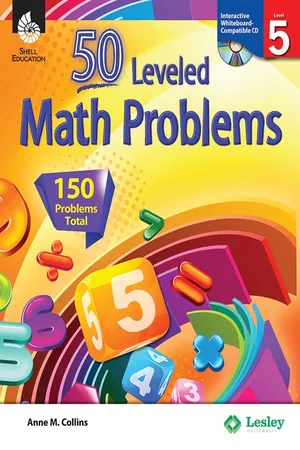
Developed in conjunction with Lesley University, this engaging resource for fifth grade provides effective, research-based strategies to help teachers differentiate problem solving in the classroom. It includes: 50 leveled math problems (150 problems total), an overview of the problem-solving process, and ideas for formative assessment of students'' problem-solving abilities. It also includes 50 mini-lessons and a student activity sheet featuring a problem tiered at three levels, plus digital resources that include electronic versions of activity sheets. This resource was developed with College and Career Readiness in mind, is aligned to the interdisciplinary themes from the Partnership for 21st Century Skills, and supports core concepts of STEM instruction.
- 147 pages
- English
- PDF
- Available on iOS & Android
eBook - PDF
50 Leveled Math Problems Level 5
About this book
Information
Table of contents
- Cover
- Credits
- Page 3 - Table of Contents
- Page 4 - Table of Contents (cont.)
- Page 5 - Problem Solving in Mathematics Instruction
- Page 7 - Understanding the Problem-Solving Process
- Page 12 - Problem-Solving Strategies
- Page 14 - Ask, Don’t Tell
- Page 15 - Differentiating with Leveled Problems
- Page 18 - Management and Assessment
- Page 22 - How to Use This Book
- Page 26 - Correlations to Standards
- Page 32 - In What Order?
- Page 34 - Order Counts
- Page 36 - Number Patterns
- Page 38 - Geometric Patterns
- Page 40 - How Else Might I Look?
- Page 42 - Where Am I?
- Page 44 - How Do I Change?
- Page 46 - What’s Our Relation?
- Page 48 - Name My Number
- Page 50 - Rectangular Products
- Page 52 - Whatever Remains
- Page 54 - Grouping or Sharing?
- Page 56 - Dealing with Decimals
- Page 58 - Expanded Form
- Page 60 - Travel Expenses
- Page 62 - Computing with Decimals
- Page 64 - Dizzying Decimals
- Page 66 - Estimating Decimals
- Page 68 - About How Much?
- Page 70 - Where Do I Fit?
- Page 72 - Ribbons and Bows
- Page 74 - Fractional Sums
- Page 76 - What’s the Difference?
- Page 78 - It’s Close to What?
- Page 80 - More or Less
- Page 82 - Fractional Areas
- Page 84 - The Product Is Smaller
- Page 86 - Fair Sharing, Equal Groups
- Page 88 - Map Reading
- Page 90 - Fill It Up
- Page 92 - How Spacious Is It?
- Page 94 - Cubic Views
- Page 96 - Volume in Practice
- Page 98 - What’s My Unit?
- Page 100 - Metrically Speaking
- Page 102 - How Much Is There?
- Page 104 - All in a Line
- Page 106 - What Is the Favorite?
- Page 108 - Stem-and-Leaf Plots
- Page 110 - What Does It Mean?
- Page 112 - The Plot Thickens
- Page 114 - One or the Other
- Page 116 - Congruency
- Page 118 - Classifying Figures
- Page 120 - Plots A Lot
- Page 122 - Flips, Slides, and Turns
- Page 124 - What Is the Angle?
- Page 126 - Sort It Out
- Page 128 - Geometric Nets
- Page 130 - Graph It
- Page 132 - Appendix A: Student Response Form
- Page 133 - Appendix B: Observation Form
- Page 134 - Appendix C: Record-Keeping Chart
- Page 135 - Appendix D: Answer Key
- Page 142 - Appendix E: References Cited
- Page 143 - Appendix F: Contents of the Teacher Resource CD
- Thank You Page
Trusted by 375,005 students
Access to over 1.5 million titles for a fair monthly price.
Study more efficiently using our study tools.
Frequently asked questions
Yes, you can cancel anytime from the Subscription tab in your account settings on the Perlego website. Your subscription will stay active until the end of your current billing period. Learn how to cancel your subscription
No, books cannot be downloaded as external files, such as PDFs, for use outside of Perlego. However, you can download books within the Perlego app for offline reading on mobile or tablet. Learn how to download books offline
Perlego offers two plans: Essential and Complete
- Essential is ideal for learners and professionals who enjoy exploring a wide range of subjects. Access the Essential Library with 800,000+ trusted titles and best-sellers across business, personal growth, and the humanities. Includes unlimited reading time and Standard Read Aloud voice.
- Complete: Perfect for advanced learners and researchers needing full, unrestricted access. Unlock 1.5M+ books across hundreds of subjects, including academic and specialized titles. The Complete Plan also includes advanced features like Premium Read Aloud and Research Assistant.
We are an online textbook subscription service, where you can get access to an entire online library for less than the price of a single book per month. With over 1.5 million books across 990+ topics, we’ve got you covered! Learn about our mission
Look out for the read-aloud symbol on your next book to see if you can listen to it. The read-aloud tool reads text aloud for you, highlighting the text as it is being read. You can pause it, speed it up and slow it down. Learn more about Read Aloud
Yes! You can use the Perlego app on both iOS and Android devices to read anytime, anywhere — even offline. Perfect for commutes or when you’re on the go.
Please note we cannot support devices running on iOS 13 and Android 7 or earlier. Learn more about using the app
Please note we cannot support devices running on iOS 13 and Android 7 or earlier. Learn more about using the app
Yes, you can access 50 Leveled Math Problems Level 5 by Anne Collins in PDF and/or ePUB format. We have over 1.5 million books available in our catalogue for you to explore.