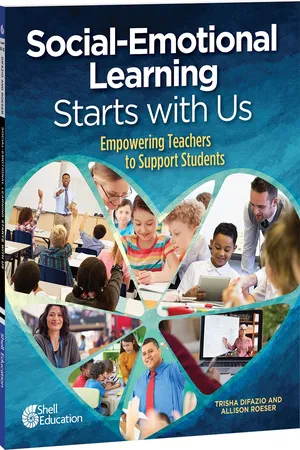
eBook - PDF
Social-Emotional Learning Starts With Us
Empowering Teachers to Support Students
- 168 pages
- English
- PDF
- Available on iOS & Android
eBook - PDF
Social-Emotional Learning Starts With Us
Empowering Teachers to Support Students
About this book
This essential teacher resource will guide you in successfully implementing Social-Emotional Learning (SEL) strategies into every day instruction while looking at how to foster your own emotional awareness with support. Learn how to create a classroom community centered around SEL engagement to help students succeed in the classroom and beyond. You will dig into key SEL topics such as the 5 SEL Competencies, mindfulness, and feedback. Perfect for educators with a wide range of experience, this resource will empower you to explore your own SEL skills to make lasting connections in the classroom and school community.
Information
Topic
EducationSubtopic
Education Teaching MethodsTable of contents
- Cover
- Page 2 -Credits
- Page 3 - Table of Contents
- Page 4 - Table of Contents (cont.)
- Page 5 -Foreword
- Page 7 - Preface
- Page 13 - Introduction
- Page 13 - What Is Social and Emotional Learning?
- Page 15 - Why SEL?
- Page 20 - Our Why
- Page 21 - SEL Starts with Adults
- Page 30 - Equity
- Page 33 - Summary
- Page 35 - Chapter 1: Self-Awareness
- Page 35 - What Is Self-Awareness?
- Page 35 - Why Is Self-Awareness Important?
- Page 36 - Identifying One’s Emotions
- Page 39 - Identity
- Page 42 - Identifying Cultural and Linguistic Assets
- Page 44 - Having a Growth Mindset
- Page 45 - Recognizing One’s Strengths and Areas for Growth
- Page 48 - Developing Interests and a Sense of Purpose
- Page 53 - Chapter 2: Self-Management
- Page 53 - What Is Self-Management?
- Page 53 - Why Is Self-Management Important?
- Page 54 - Managing Emotions
- Page 55 - Identifying Stress
- Page 55 - Kinds of Stress
- Page 56 - Educators and Stress
- Page 56 - Managing Stress
- Page 58 - Motivation
- Page 60 - Goal Setting
- Page 65 - Personal and Collective Agency
- Page 67 - Chapter 3: Social Awareness
- Page 67 - What Is Social Awareness?
- Page 67 - Why Is Social Awareness Important?
- Page 68 - Empathy
- Page 69 - Empathy in Action
- Page 72 - Ways to Teach Empathy
- Page 73 - Calling In versus Calling Out
- Page 75 - Systemic Racism
- Page 77 - Recognizing Support and Resources
- Page 78 - Gratitude: It Is Not Just for Thanksgiving
- Page 80 - Recognizing Situational Demands
- Page 83 - Chapter 4: Relationship Skills
- Page 83 - What Are Relationship Skills?
- Page 83 - Why Are Relationship Skills Important?
- Page 84 - Developing Positive Relationships
- Page 85 - Keys to Connection Checklist
- Page 89 - Connecting Across Cultures
- Page 90 - Home-School Connections
- Page 91 - Positive Phone Calls Home
- Page 95 - Chapter 5: Responsible Decision-Making
- Page 95 - What Is Responsible Decision-Making?
- Page 96 - Why Is Responsible Decision-Making Important?
- Page 97 - Responsible Decision-Making in the Classroom
- Page 98 - Connect Choices Now with Future Goals
- Page 99 - Using Reflection in Decision-Making
- page 99 - Empathy in Decision-Making
- Page 100 - Incorporate Ethics and Morals into Decision-Making
- Page 103 - Chapter 6: Mindfulness
- Page 103 - What Is Mindfulness?
- Page 104 - Why Is Mindfulness Important?
- Page 105 - Integrating SEL and Mindfulness
- Page 106 - Breathing Strategies
- Page 109 - Chapter 7: SEL Activities
- Page 109 - Competency Connections
- Page 110 - Self-Awareness Activities
- Page 110 - Heart Art
- Page 114 - Name That Emotion
- Page 121 - Self-Management Activities
- Page 121 - What Helps Me” Wheel
- Page 127 - Calming Countdown
- Page 131 - Social Awareness Activities
- Page 131 - Perspective Detective
- Page 137 - What’s Their Story?
- page 141 - Who’s My Crew?
- Page 146 - Relationship Skills Activities
- page 146 - Keys to Connection
- Page 150 - Introduce Your Selfie/Identity Slides
- Page 155 - Responsible Decision-Making Activities
- Page 155 - SODAS (Situation, Options, Disadvantages,Advantages, Solutions)
- page 159 - T-Chart
- Page 162 - References
- Page 166 - Digital Resources
- BackCover
Trusted by 375,005 students
Access to over 1.5 million titles for a fair monthly price.
Study more efficiently using our study tools.
Frequently asked questions
Yes, you can cancel anytime from the Subscription tab in your account settings on the Perlego website. Your subscription will stay active until the end of your current billing period. Learn how to cancel your subscription
No, books cannot be downloaded as external files, such as PDFs, for use outside of Perlego. However, you can download books within the Perlego app for offline reading on mobile or tablet. Learn how to download books offline
Perlego offers two plans: Essential and Complete
- Essential is ideal for learners and professionals who enjoy exploring a wide range of subjects. Access the Essential Library with 800,000+ trusted titles and best-sellers across business, personal growth, and the humanities. Includes unlimited reading time and Standard Read Aloud voice.
- Complete: Perfect for advanced learners and researchers needing full, unrestricted access. Unlock 1.5M+ books across hundreds of subjects, including academic and specialized titles. The Complete Plan also includes advanced features like Premium Read Aloud and Research Assistant.
We are an online textbook subscription service, where you can get access to an entire online library for less than the price of a single book per month. With over 1.5 million books across 990+ topics, we’ve got you covered! Learn about our mission
Look out for the read-aloud symbol on your next book to see if you can listen to it. The read-aloud tool reads text aloud for you, highlighting the text as it is being read. You can pause it, speed it up and slow it down. Learn more about Read Aloud
Yes! You can use the Perlego app on both iOS and Android devices to read anytime, anywhere — even offline. Perfect for commutes or when you’re on the go.
Please note we cannot support devices running on iOS 13 and Android 7 or earlier. Learn more about using the app
Please note we cannot support devices running on iOS 13 and Android 7 or earlier. Learn more about using the app
Yes, you can access Social-Emotional Learning Starts With Us by Allison Roeser,Trisha DiFazio in PDF and/or ePUB format, as well as other popular books in Education & Education Teaching Methods. We have over 1.5 million books available in our catalogue for you to explore.