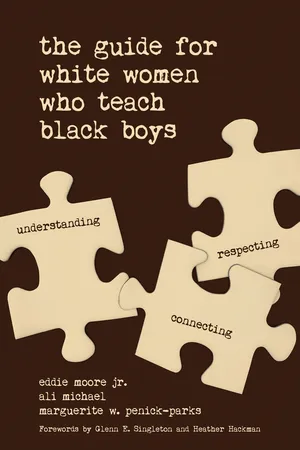
The Guide for White Women Who Teach Black Boys
- English
- ePUB (mobile friendly)
- Available on iOS & Android
The Guide for White Women Who Teach Black Boys
About this book
Empower black boys to dream, believe, achieve Schools that routinely fail Black boys are not extraordinary. In fact, they are all-too ordinary. If we are to succeed in positively shifting outcomes for Black boys and young men, we must first change the way school is "done." That's where the eight in ten teachers who are White women fit in... and this urgently needed resource is written specifically for them as a way to help them understand, respect and connect with all of their students. So much more than a call to call to actionābut that, too!ā The Guide for White Women Who Teach Black Boys brings together research, activities, personal stories, and video interviews to help us all embrace the deep realities and thrilling potential of this crucial American task.With Eddie, Ali, and Marguerite as your mentors, you will learn how to:
- Develop learning environments that help Black boys feel a sense of belonging, nurturance, challenge, and love at school
- Change school culture so that Black boys can show up in the wholeness of their selves
- Overcome your unconscious bias and forge authentic connections with your Black male students
If you are a teacher who is afraid to talk about race, that's okay. Fear is a normal human emotion and racial competence is a skill that can be learned. We promise that reading this extraordinary guide will be a life-changing first step forward... for both you and the students you serve.
About the Authors
Dr. Eddie Moore, Jr., has pursued and achieved success in academia, business, diversity, leadership, and community service. In 1996, he started America & MOORE, LLC to provide comprehensive diversity, privilege, and leadership trainings/workshops. Dr. Moore is recognized as one of the nation's top motivational speakers and educators, especially for his work with students Kā16. Dr. Moore is the Founder/Program Director for the White Privilege Conference, one of the top national and international conferences for participants who want to move beyond dialogue and into action around issues of diversity, power, privilege, and leadership. Ali Michael, Ph.D., is the co-founder and director of the Race Institute for Kā12 Educators, and the author of Raising Race Questions: Whiteness, Inquiry, and Education, winner of the 2017 Society of Professors of Education Outstanding Book Award. She is co-editor of the bestselling Everyday White People Confront Racial and Social Injustice and sits on the editorial board of the journal, Whiteness and Education. Dr. Michael teaches in the mid-career doctoral program at the University of Pennsylvania's Graduate School of Education, as well as the Graduate Counseling Program at Arcadia University. Dr. Marguerite W. Penick-Parks currently serves as Chair of Educational Leadership and Policy at the University of Wisconsin, Oshkosh. Her work centers on issues of power, privilege, and oppression in relationship to issues of curriculum with a special emphasis on the incorporation of quality literature in Kā12 classrooms. She appears in the movie, "Mirrors of Privilege: Making Whiteness Visible, " by the World Trust Organization. Her most recent work includes a joint article on creating safe spaces for discussing White privilege with preservice teachers.
Frequently asked questions
- Essential is ideal for learners and professionals who enjoy exploring a wide range of subjects. Access the Essential Library with 800,000+ trusted titles and best-sellers across business, personal growth, and the humanities. Includes unlimited reading time and Standard Read Aloud voice.
- Complete: Perfect for advanced learners and researchers needing full, unrestricted access. Unlock 1.4M+ books across hundreds of subjects, including academic and specialized titles. The Complete Plan also includes advanced features like Premium Read Aloud and Research Assistant.
Please note we cannot support devices running on iOS 13 and Android 7 or earlier. Learn more about using the app.
Information
Table of contents
- Cover
- Half Title
- Acknowledgements
- Title Page
- Copyright Page
- Contents
- Forewords Foreword 1
- Foreword 2
- Acknowledgments
- About the Authors
- About the Contributors
- Introduction Welcome to The Guide for White Women Who Teach Black Boys
- Understanding
- Part 1 Exploring the Self
- Chapter 1 Ready to Make a Difference, the Old-Fashioned Way
- Chapter 2 The State of the White Woman Teacher
- Chapter 3 Advancing the Success of Boys and Men of Color
- Chapter 4 Understanding Unconscious Bias as One More Tool in the Committed White Teacherās Equity Toolkit
- Chapter 5 White Female Teachers and Black Boys Right Teachers and (Mis)Understood Boys
- Chapter 6 White Racial Identity Development
- Chapter 7 What If Being Called Racist Is the Beginning, Not the End, of the Conversation?
- Chapter 8 What Does It Mean to Be a White Teacher?
- Part 2 Understanding the Constraints and Challenging the Narratives About Who Black Boys Are and Who White Women Can Be
- Chapter 9 Respecting Black Boys and Their History
- Chapter 10 āI Can Switch My Language, But I Canāt Switch My Skinā What Teachers Must Understand About Linguistic Racism
- Chapter 11 Identity Safety as an Antidote to Stereotype Threat
- Chapter 12 The Science Behind Psychological Verve and What It Means for Black Students
- Chapter 13 The Visit
- Chapter 14 Rewriting the Narrative
- Chapter 15 āDonāt LeanāJump Inā The Fierce Urgency to Confront, Dismantle, and (Re)write the Historical Narrative of Black Boys in Educational Institutions
- Respecting
- Part 3 Respecting the Broad Diversity of Black Boysā Experiences and Identities
- Chapter 16 Strategies for Showing Love to Black Boys
- Chapter 17 White Privilege and Black Excellence Two Terms That Iāve Been āAfraidā of for Much of My Life
- Chapter 18 Black Boys and Their Racial Identity Learning How They Fit Into Society and in Your Classroom
- Chapter 19 Teaching Black Boys During Childhood A Counternarrative and Considerations
- Chapter 20 āHow Dare You Make This About Race?!ā Centering Race, Gender, and Poverty
- Chapter 21 The N!gga(er) in Me . . .
- Chapter 22 Blackness/Transness Two Targets on My Back
- Chapter 23 White Teachers and the Power to Transform Early Childhood Educators and the Potential for Lasting Harm
- Chapter 24 Learn About Us Before You Teach (About) Us Queer Black Boys
- Chapter 25 Black Male Students and Teachers in Kā12 Classrooms Strategies for Support to Increase Performance as Students and Professionals
- Part 4 Relationships With Parents, Colleagues, and Community
- Chapter 26 Helping Amazing Black Boys Become Amazing Black Men
- Chapter 27 Connecting With Black Students and Parents Equal Vision
- Chapter 28 Activating Inclusiveness
- Chapter 29 Belief, Pedagogy, and Practice Strategies for Building Powerful Classroom Communities
- Chapter 30 Ruminations From the Intersections of a #BlackMommyActivist1
- Chapter 31 Find Freedom in the Classroom: A Love Letter to My Babiesā Teachers
- Connecting
- Part 5 Connecting Student Success and Failure to School Structures and Classroom Strategies
- Chapter 32 Start Out Firm
- Chapter 33 A Parable of Academic Misgivings The Educatorās Role in Addressing College Undermatch
- Chapter 34 The Collusion of Social Norms and Working With Interracial Families
- Chapter 35 What Are We Doing to Support āTheseā Students to Meet Their Potential? Strategies for Creating Equitable Classrooms
- Chapter 36 Interrupting School Structures ADD/ADHD Overidentification and How Black Cultural Styles Are Often Confused for ADD
- Chapter 37 Football, Sports, and Moore Using School Structures to Get More out of Black Boys
- Part 6 Connecting Student Success to School Structures and Classroom Strategies
- Chapter 38 Strategies That De-escalate Conflict in the Classroom
- Chapter 39 Meeting Students Where They Are Project-Based Learning and Critical Thinking Skills
- Chapter 40 Black Faces and White Spaces Recognizing and Supporting Black Boys in Gifted Education
- Chapter 41 The Book Matters Using the Color-Coded Bloom-Banks Matrix to Support the Literacy and Engagement of Black Boys
- Chapter 42 Books and Curriculum What to Read With Black Males in Elementary School to Create a Strong Foundation of Positive Racial Identity Development
- Chapter 43 Global Skills Beyond the Classroom and the Playground
- Outtro Remember, Black Girls Arenāt Doing āJust Fineā Supporting Black Girls in the Classroom
- Video Resources
- References
- Index
- Publisher Note
- Publisher Note