eBook - PDF
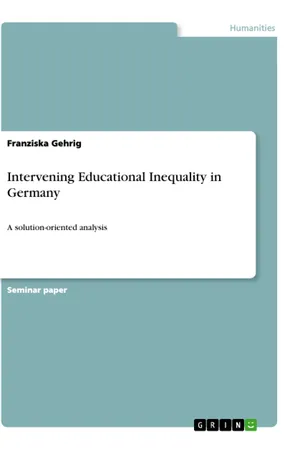
Intervening Educational Inequality in Germany
A solution-oriented analysis
- 22 pages
- English
- PDF
- Available on iOS & Android
eBook - PDF
About this book
Seminar paper from the year 2021 in the subject Sociology - Miscellaneous, grade: 1,0, University of Tubingen (Institut für Soziologie), course: Nature vs. Nurture? Childhood Inequalities from an interdisciplinary perspective, language: English, abstract: Education produces and reprodues inequality. Germany still scores at the top in social inequality in the education system compared to other European countries. Differences in families' given resources as unequally distributed starting conditions can, in principle, be compensated by schools. However, reality differs. Three main improvement areas are identified: schooling, kindergarten and school types/ tracking. These are based on an analysis of the determinants of educational success and inequality, the primary and secondary effects of social origin in the German education system. This paper focuses on pre-school, primary and secondary education and aims to find empirically based answers for inequalities and disadvantages. Five hypotheses are tested via reviewing studies and literature. The main findings are that summer schools have a significant effect on the performance of children and are able to reverse the phenomenon of performance fallback of low SES children and children with migration background – especially when German is their second language. Additionally, the usefulness of kindergarten, nurseries and KiTa's for improving language skills of children with migration background and for overall compensating family resources is well known and acknowledged. Gesamtschulen show an impressionable impact on reducing secondary effects of social orgin. However, the most promising hypothesis to delay or abolish the (early) tracking lacks strong evidence and empirical data for Germany – no final conclusion can be drawn here.
Information
Table of contents
Trusted by 375,005 students
Access to over 1.5 million titles for a fair monthly price.
Study more efficiently using our study tools.
Frequently asked questions
Yes, you can cancel anytime from the Subscription tab in your account settings on the Perlego website. Your subscription will stay active until the end of your current billing period. Learn how to cancel your subscription
No, books cannot be downloaded as external files, such as PDFs, for use outside of Perlego. However, you can download books within the Perlego app for offline reading on mobile or tablet. Learn how to download books offline
Perlego offers two plans: Essential and Complete
- Essential is ideal for learners and professionals who enjoy exploring a wide range of subjects. Access the Essential Library with 800,000+ trusted titles and best-sellers across business, personal growth, and the humanities. Includes unlimited reading time and Standard Read Aloud voice.
- Complete: Perfect for advanced learners and researchers needing full, unrestricted access. Unlock 1.5M+ books across hundreds of subjects, including academic and specialized titles. The Complete Plan also includes advanced features like Premium Read Aloud and Research Assistant.
We are an online textbook subscription service, where you can get access to an entire online library for less than the price of a single book per month. With over 1.5 million books across 990+ topics, we’ve got you covered! Learn about our mission
Look out for the read-aloud symbol on your next book to see if you can listen to it. The read-aloud tool reads text aloud for you, highlighting the text as it is being read. You can pause it, speed it up and slow it down. Learn more about Read Aloud
Yes! You can use the Perlego app on both iOS and Android devices to read anytime, anywhere — even offline. Perfect for commutes or when you’re on the go.
Please note we cannot support devices running on iOS 13 and Android 7 or earlier. Learn more about using the app
Please note we cannot support devices running on iOS 13 and Android 7 or earlier. Learn more about using the app
Yes, you can access Intervening Educational Inequality in Germany by Franziska Gehrig in PDF and/or ePUB format, as well as other popular books in Social Sciences & Sociology. We have over 1.5 million books available in our catalogue for you to explore.