A bold reinterpretation of perennial debates over the origins and development of slavery in colonial English North America
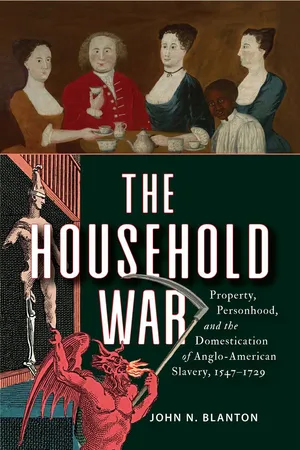
The Household War offers a bold reinterpretation of perennial debates over the origins and development of slavery in colonial English North America. John N. Blanton argues that the law and practice of slavery in the empire's earliest American colonies were shaped by a tension between two competing definitions of the institution. One strand of thought, war-slavery ideology, claimed that the power of life and death transformed war captives into chattel slaves. The power to kill defined both war and slavery. But bringing war captives into enslavers' private households was a dangerous proposition, and so a parallel "domestication" ideology emerged calling for limitations on the power of enslavers and the recognition of the enslaved as persons held to labor in a variant of English servitude.
The Household War examines how the tensions between war-slavery and domestication ideologies, along with crucial political, economic, and cultural differences, shaped the development of slavery in Virginia and Massachusetts from their founding through 1729, creating distinct systems of bondage in England's flagship mainland colonies. In Massachusetts, where a diversified and dynamic commercial economy afforded opportunities for mobility and access to material resources, the dominance of domestication ideology enabled enslaved people to negotiate their bondage, attain free status, and build free Black households and communities. Virginia, however, committed itself to war-slavery early in its development, with enslaved people defined as articles of property subject to enslavers' power of life and death while the extreme inequality of plantation society made free Black household formation nearly impossible. Long before American independence highlighted their differences, then, Massachusetts and Virginia were already on distinct trajectories, laying the foundation for a future house divided on the question of slavery.
eBook - ePub
The Household War
Property, Personhood, and the Domestication of Anglo-American Slavery, 1547–1729
- English
- ePUB (mobile friendly)
- Available on iOS & Android
eBook - ePub
The Household War
Property, Personhood, and the Domestication of Anglo-American Slavery, 1547–1729
About this book
Information
Subtopic
Early American HistoryIndex
HistoryTable of contents
- Cover
- Title Page
- Copyright
- Dedication
- Contents
- Introduction. War, Property, and Personhood
- Chapter 1. War, Capitalism, and the Domestication of Slavery, 1547–1729
- Chapter 2. “Parts and Members of the State”: Creating Slaveries and Capitalisms in Early Anglo-America, 1607–1642
- Chapter 3. A “Heynous and Cryinge Sinn”: Slavery and Domestication in the Imperial English Civil Wars and Revolutions, 1642–1660
- Chapter 4. “A Two-Fold Use”: The Human Tragedy of the Anglo-American Counterrevolution, 1660–1688
- Chapter 5. A Williamite Moment: The Problem of Domestication in the Age of War-Slavery, 1689–1729
- Epilogue. Through War, Toward Revolution, Beyond Domestication?
- Notes
- Index
- Acknowledgments
Trusted by 375,005 students
Access to over 1.5 million titles for a fair monthly price.
Study more efficiently using our study tools.
Frequently asked questions
Yes, you can cancel anytime from the Subscription tab in your account settings on the Perlego website. Your subscription will stay active until the end of your current billing period. Learn how to cancel your subscription
No, books cannot be downloaded as external files, such as PDFs, for use outside of Perlego. However, you can download books within the Perlego app for offline reading on mobile or tablet. Learn how to download books offline
Perlego offers two plans: Essential and Complete
- Essential is ideal for learners and professionals who enjoy exploring a wide range of subjects. Access the Essential Library with 800,000+ trusted titles and best-sellers across business, personal growth, and the humanities. Includes unlimited reading time and Standard Read Aloud voice.
- Complete: Perfect for advanced learners and researchers needing full, unrestricted access. Unlock 1.5M+ books across hundreds of subjects, including academic and specialized titles. The Complete Plan also includes advanced features like Premium Read Aloud and Research Assistant.
We are an online textbook subscription service, where you can get access to an entire online library for less than the price of a single book per month. With over 1.5 million books across 990+ topics, we’ve got you covered! Learn about our mission
Look out for the read-aloud symbol on your next book to see if you can listen to it. The read-aloud tool reads text aloud for you, highlighting the text as it is being read. You can pause it, speed it up and slow it down. Learn more about Read Aloud
Yes! You can use the Perlego app on both iOS and Android devices to read anytime, anywhere — even offline. Perfect for commutes or when you’re on the go.
Please note we cannot support devices running on iOS 13 and Android 7 or earlier. Learn more about using the app
Please note we cannot support devices running on iOS 13 and Android 7 or earlier. Learn more about using the app
Yes, you can access The Household War by John N. Blanton in PDF and/or ePUB format, as well as other popular books in History & Early American History. We have over 1.5 million books available in our catalogue for you to explore.