eBook - ePub
Channing of Tanta
About this book
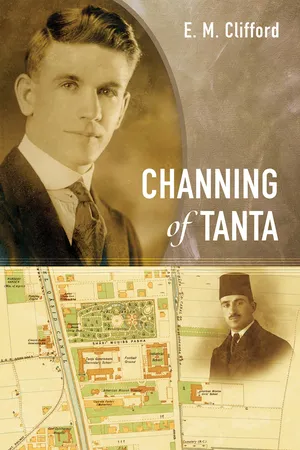
Benjamin Channing was born into a prominent New England family with a respectable fortune, an Ivy League pedigree, and stalwart Presbyterian values of rectitude and public service. Friendly, helpful, honest, and optimistic, Ben excelled at school and sports, unwittingly becoming just the kind of young man that recruiting mission agencies longed for in their wildest dreams.
In 1918, his peers at Yale and Princeton were humming with idealism and a desire for challenge and adventure. The Student Volunteer Movement for Foreign Missions absorbed this energy and redirected it. Ben soon found himself committed to the evangelization of the world and on his way to Egypt.
But the ancient land of Egypt in the 1920s was balanced on the edge of enormous social and cultural change. Centuries of foreign domination were creating an indigenous rebellion against Ottoman and British imperialism. Forces were struggling against the heavy hand of Western economic and military assets, grappling with the decidedly mixed legacy of European and American Christian missionary work in Egypt, and engaging with a radically new concept of powerful political Islam.
Tested in many ways, Benjamin Channing did his best … and somehow both succeeded and failed.
Information
Topic
Theology & ReligionSubtopic
Christian MinistryTable of contents
- Title Page
- Preface
- October 1922–November 1923
- Chapter 1
- Chapter 2
- Chapter 3
- Chapter 4
- Chapter 5
- Chapter 6
- Chapter 7
- Chapter 8
- Chapter 9
- Selected Sources
Trusted by 375,005 students
Access to over 1.5 million titles for a fair monthly price.
Study more efficiently using our study tools.
Frequently asked questions
Yes, you can cancel anytime from the Subscription tab in your account settings on the Perlego website. Your subscription will stay active until the end of your current billing period. Learn how to cancel your subscription
No, books cannot be downloaded as external files, such as PDFs, for use outside of Perlego. However, you can download books within the Perlego app for offline reading on mobile or tablet. Learn how to download books offline
Perlego offers two plans: Essential and Complete
- Essential is ideal for learners and professionals who enjoy exploring a wide range of subjects. Access the Essential Library with 800,000+ trusted titles and best-sellers across business, personal growth, and the humanities. Includes unlimited reading time and Standard Read Aloud voice.
- Complete: Perfect for advanced learners and researchers needing full, unrestricted access. Unlock 1.5M+ books across hundreds of subjects, including academic and specialized titles. The Complete Plan also includes advanced features like Premium Read Aloud and Research Assistant.
We are an online textbook subscription service, where you can get access to an entire online library for less than the price of a single book per month. With over 1.5 million books across 990+ topics, we’ve got you covered! Learn about our mission
Look out for the read-aloud symbol on your next book to see if you can listen to it. The read-aloud tool reads text aloud for you, highlighting the text as it is being read. You can pause it, speed it up and slow it down. Learn more about Read Aloud
Yes! You can use the Perlego app on both iOS and Android devices to read anytime, anywhere — even offline. Perfect for commutes or when you’re on the go.
Please note we cannot support devices running on iOS 13 and Android 7 or earlier. Learn more about using the app
Please note we cannot support devices running on iOS 13 and Android 7 or earlier. Learn more about using the app
Yes, you can access Channing of Tanta by E. M. Clifford in PDF and/or ePUB format, as well as other popular books in Theology & Religion & Christian Ministry. We have over 1.5 million books available in our catalogue for you to explore.