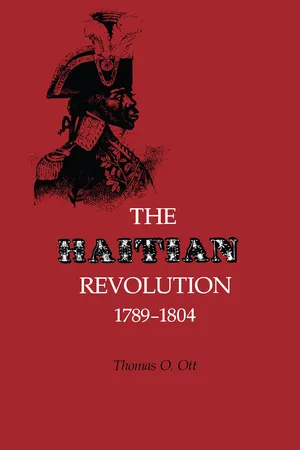
On the night of August 22, 1791, thousands of small illuminated specks could be seen on the otherwise darkened Plaine du Nord of Saint-Domingue in the Caribbean. With a torch in one hand and a knife in the other, the slave of Saint-Domingue was destroying a society which had suppressed him for nearly one hundred years. But the agonies of that night were only the beginning of a great socioeconomic explosion, lasting almost thirteen years. During that period Saint-Domingue emerged as Haiti, the first Black republic in the Western Hemisphere.
Although the American, French, Russian, and Mexican revolutions have received the attention of many scholars, the Haitian Revolution has remained in relative obscurity. Even those historians who have made a study of that turmoil often viewed much of it ideologically. In The Haitian Revolution, Thomas O. Ott provides a long-needed objective synthesis of the events and ideas which shaped this heroic period. In doing so, he has contributed significant new details and persuasive interpretations.
The background of the Haitian Revolution was one of dreams and lost hopes, the substance of other great upheavals. Against this background, Professor Ott identifies and throws light upon a number of themes: the influence of the French Revolution, the abolition of slavery, the fear of revolt among other slave societies, the intervention of foreign powers, and the rise of a Black republic. Yet, he makes evident, the major theme of the period was not an event but a man—Toussaint L'Ouverture.
Leaving a rather idyllic environment at Breda Plantation on the Plaine du Nord, Toussaint joined the rebels and rose from obscurity to prominence within an astonishingly short timespan. With the dexterity of a tightrope walker and the finesse of a fencer, Toussaint had outplayed all but one of his rivals for power by mid-1800. That one who remained, however, was Napoleon Bonaparte. In the final contest between these two men, Toussaint, dying a tragic death in a dank French prison, would see his vision of Haitian independence near oblivion. But the fading dream was rescued by Jean Jacques Dessalines, Toussaint’s fierce lieutenant, and by the Haitian people themselves.
To achieve objectivity, Professor Ott has gone beyond the sources traditionally consulted. He has utilized numerous newspaper accounts, mainly written by observant Yankee seamen, and has also investigated the American consul reports of the period. But the many French references, such as the heretofore untapped papers of Donatien Rochambeau, have not been neglected.