- 453 pages
- English
- PDF
- Available on iOS & Android
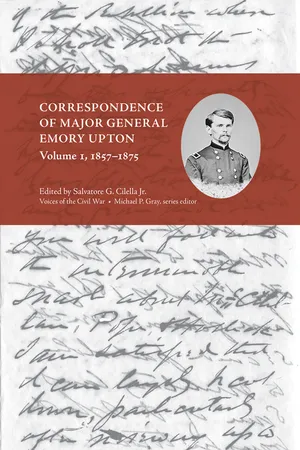
Correspondence of Major General Emory Upton, Vol. 1, 1857–1875
About this book
Emory Upton (1839–1881) was thrust into the Civil War immediately upon graduation from the United States Military Academy at West Point in May of 1861. He was wounded three times during the war. He participated in nearly every major battle in the Eastern Theater including Fredericksburg, Gettysburg, and Spotsylvania, where he led a prominent attack on entrenched Confederate positions—a signal of Upton’s brilliance as an officer and of his military creativity that foreshadowed his later work in revising the Army’s tactics. Upton was mustered out of service in 1866 and later named commandant of cadets at West Point, a position that carved a path for Upton to focus more on Army tactics and reforms.
Until now, the only lenses through which scholars could study Upton were two biographies published nearly a century apart but practically identical in scope and treatment. The two-volume Correspondence of Major General Emory Upton follows Upton through his enrollment at West Point to his extensive Army activities following the Civil War and contains the bulk of his wartime correspondence. Volume one, with Upton’s Civil War correspondence encompasses both larger battle details and day-to-day activities in the life of a soldier. His letters reveal a mercurial individual: a humorous person used to suffering and rejoicing, who could be flawed and brilliant, vain and humble.
These selected letters and reports, expertly annotated and gathered from repositories across the country, present a more complex, human Emory Upton. He is both the “clean, pure, and spotless” individual of biographies and the ambitious, yet flawed Army officer obsessed with his career. These volumes explore his trials and frustrations as well as his triumphs.
Salvatore G. Cilella Jr., now retired, was president of the Atlanta Historical Society. He is the author of Upton’s Regulars: The 121st New York Infantry in the American Civil War and Fund Raising for Small Museums in Good Times and Bad.
Frequently asked questions
- Essential is ideal for learners and professionals who enjoy exploring a wide range of subjects. Access the Essential Library with 800,000+ trusted titles and best-sellers across business, personal growth, and the humanities. Includes unlimited reading time and Standard Read Aloud voice.
- Complete: Perfect for advanced learners and researchers needing full, unrestricted access. Unlock 1.4M+ books across hundreds of subjects, including academic and specialized titles. The Complete Plan also includes advanced features like Premium Read Aloud and Research Assistant.
Please note we cannot support devices running on iOS 13 and Android 7 or earlier. Learn more about using the app.
Information
Table of contents
- Contents
- Foreword, Micael P. Gray
- Acknowledgments
- Introduction
- Abbreviations
- Chapter 1. Cadet: February 1857-April 1861
- Chapter 2. Artillery Commander: May 1861–September 1862
- Chapter 3. Infantry Commander: October 1862–September 1863
- Chapter 4. Rappahannock Station to Winter Camp: November 1863–April 1864
- Chapter 5. The Overland Campaign and the Shenandoah Valley: May 1864-September 1864
- Chapter 6. The Western Theater and Wilson’s Raid: October 1864-July 1865
- Chapter 7. The Postwar Years and Tactics: August 1865–December 1868
- Chapter 8. Love and Death: January 1869–June 1870
- Chapter 9. Commandant of Cadets: June 1870–December 1872
- Chapter 10. Testing the Tactics: January 1873–June 1875
- Appendix: 1852 Letter
- Bibliography
- Index