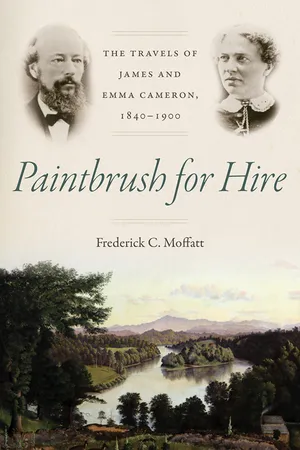
"I was pulled into the story and read every word."—Randolph Delehanty, author of Art in the American South: Works from the Odgen Collection
Throughout the nineteenth-century, itinerant painters traveled the length and breadth of Europe and American in search of patronage. In the company of the his crupulous wife, Emma S. Cameron (1825–1907), the Scots-born James Cameron (1816–1882) sought to fulfill his ambitious dream of becoming an artist.
Working primarily as a landscapist and portraitist—he was also an inventor, a missionary, an ordained minister, a land agent, farmer, clothing merchant, and Sunday school teacher—Cameron produced a small collection of paintings during the ten-year period the couple resided in East Tennessee and the American South. Driven by the wife's lively journals, correspondence, and Civil War diary, Moffatt's narrative details the couple's marriage, their extended honeymoon in revolutionary Italy and, following a brief excursion in the Adirondacks, their subsequent residencies in Knoxville, Chattanooga, Memphis, Nashville, Augusta, central Mississippi, and New Orleans, between 1856 and 1868. While in Chattanooga, they settled near Col. James A. Whiteside's fashionable summer resort, Lookout Mountain Hotel, where James reigned as resident artist and Emma, reluctantly, served as the house nurse and social entertainer. In the late 1860s they lived in Maine and, after 1874, in California, where they founded separate Presbyterian churches.
The book emphasizes Cameron's painting career, the patrons who supported it, and discusses his best-known works, all of which are reproduced here. The study demonstrated how persisted while working under a cultural cloud that often devalued artistic achievement Emma's journals reveal her to be a perceptive observer of Protestant middle class "life-on-the-run" and yields insight into historic events in the making, including the Italian Risorgimento, the American Civil War, and the settlement of America's Western frontier. Moffatt's detailed joint biography provides a valuable contribution to women's studies, art history, nineteenth-century frontier expansionism, and social history.