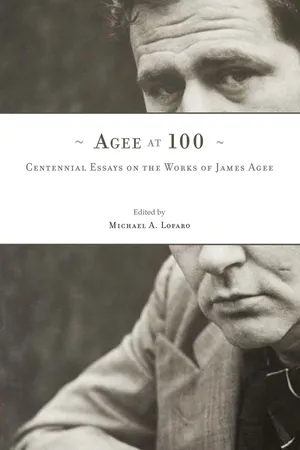
Drawn mainly from the centennial anniversary symposium on James Agee held at the University of Tennessee in the fall of 2009, the essays of Agee at 100 are as diverse in topic and purpose as is Agee's work itself. Often devalued during his life by those who thought his breadth a hindrance to greatness, Agee's achievements as a poet, novelist, journalist, essayist, critic, documentarian, and screenwriter are now more fully recognized. With its use of previously unknown and recently recovered materials as well as established works, this groundbreaking new collection is a timely contribution to the resurgence of interest in Agee's significance.
The essays in this collection range from the scholarly to the personal, and all offer insight into Agee's writing, his cultural influence, and ultimately Agee himself. Dwight Garner opens with his reflective essay on 'Why Agee Matters.' Several essays present almost entirely new material on Agee. Paul Ashdown writes on Agee's book reviews, which, unlike Agee's film criticism, have received scant attention. With evidence from two largely unstudied manuscripts, Jeffrey Couchman sets the record straight on Agee's contribution to the screenplay for The African Queen and delves as well into his television "miniseries"screenplay Mr. Lincoln. John Wranovics treats Agee's lesser-known films—the documentaries In the Street and The Quiet One and the Filipino epic Genghis Khan. Jeffrey J. Folks wrestles with Agee's "culture of repudiation" while James A. Crank investigates his perplexing treatment of race in his prose. Jesse Graves and Andrew Crooke provide new analyses of Let Us Now Praise Famous Men, and Michael A. Lofaro and Philip Stogdon both discuss Lofaro's recently restored text of A Death in the Family. David Madden closes the collection with his short story "Seeing Agee in Lincoln," an imagined letter from Agee to his longtime confidante Father Flye.
The contributors to Agee at 100 utilize materials new and old to reveal the true importance of Agee's range of cultural sensibility and literary ability. Film scholars will also find this collection particularly engrossing, as will anyone fascinated by the work of the author rightly deemed the "sovereign prince of the English language."