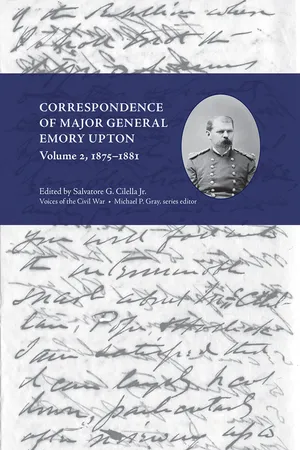
Emory Upton (1839–1881) was thrust into the Civil War immediately upon graduation from the United States Military Academy at West Point in May of 1861. He was wounded three times during the war. He participated in nearly ever major battle in the Eastern Theater including Fredericksburg, Gettysburg, and Spotsylvania, where he led a prominent attack on entrenched Confederate positions—a signal of Upton's brilliance as an officer and of his military creativity that foreshadowed his later work in revising the Army's tactics. Upton was mustered out of service in 1866 and later named commandant of cadets at West Point, a position that carved a path for Upton to focus more on Army tactics and reforms.
Until now, the only lenses through which scholars could study Upton were two biographies published nearly a century apart but practically identical in scope and treatment of Upton. The two-volume Correspondence of Major General Emory Upton follows Upton through his enrollment at West Point to his extensive Army activities following the Civil War and contains the bulk of Emory Upton's wartime correspondence. Volume two collects Upton's foreign correspondence and observations on military tactics and Army reform. At the behest of U.S. Army Commanding General William T. Sherman, Upton was sent on a tour to study the armies of Asia and Europe, and more specifically the German army after conclusion of the Franco–Prussian War. This tour resulted in the publication of his monumental The Armies of Europe and Asia, which warned that the U.S. Army was woefully below the standards of European nations, and between Upton's death in 1881 and the turn of the twentieth century, military policy was fiercely debated in both the military and popular press. Upton's ideas on reform were often central to the arguments, and his letters and writings provoked a wide range of discussion over military and, inevitably, civilian issues.
These selected letters and reports, expertly annotated and gathered from repositories across the country, present a more complex, human Emory Upton. He is both the "clean, pure, and spotless" individual of Michie's biographies and the ambitious, yet flawed Army officer obsessed with his career. These volumes explore his trials and frustrations as well as his triumphs.