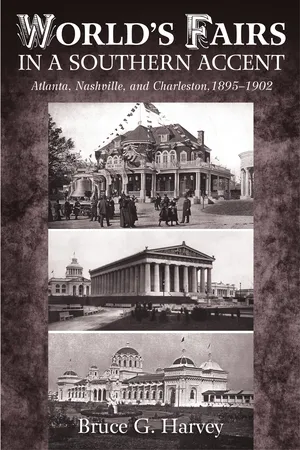
The South was no stranger to world’s fairs prior to the end of the nineteenth century. Atlanta first hosted a fair in the 1880s, as did New Orleans and Louisville, but after the 1893 World’s Columbian Exposition in Chicago drew comparisons to the great exhibitions of Victorian-era England, Atlanta’s leaders planned to host another grand exposition that would not only confirm Atlanta as an economic hub the equal of Chicago and New York, but usher the South into the nation’s industrial and political mainstream. Nashville and Charleston quickly followed suit with their own exhibitions.
In the 1890s, the perception of the South was inextricably tied to race, and more specifically racial strife. Leaders in Atlanta, Nashville, and Charleston all sought ways to distance themselves from traditional impressions about their respective cities, which more often than not conjured images of poverty and treason in Americans barely a generation removed from the Civil War. Local business leaders used large-scale expositions to lessen this stigma while simultaneously promoting culture, industry, and economic advancement. Atlanta’s Cotton States and International Exposition presented the city as a burgeoning economic center and used a keynote speech by Booker T. Washington to gain control of the national debate on race relations. Nashville’s Tennessee Centennial and International Exposition chose to promote culture over mainstream success and marketed Nashville as a “Centennial City” replete with neoclassical architecture, drawing on its reputation as “the Athens of the south.” Charleston’s South Carolina Inter-State and West Indian Exposition followed in the footsteps of Atlanta’s exposition. Its new class of progressive leaders saw the need to reestablish the city as a major port of commerce and designed the fair around a Caribbean theme that emphasized trade and the corresponding economics that would raise Charleston from a cotton exporter to an international port of interest.
Bruce G. Harvey studies each exposition beginning at the local and individual level of organization and moving upward to explore a broader regional context. He argues that southern urban leaders not only sought to revive their cities but also to reinvigorate the South in response to northern prosperity. Local businessmen struggled to manage all the elements that came with hosting a world’s fair, including raising funds, designing the fairs’ architectural elements, drafting overall plans, soliciting exhibits, and gaining the backing of political leaders. However, these businessmen had defined expectations for their expositions not only in terms of economic and local growth but also considering what an international exposition had come to represent to the community and the region in which they were hosted. Harvey juxtaposes local and regional aspects of world’s fair in the South and shows that nineteenth-century expositions had grown into American institutions in their own right.
In the 1890s, the perception of the South was inextricably tied to race, and more specifically racial strife. Leaders in Atlanta, Nashville, and Charleston all sought ways to distance themselves from traditional impressions about their respective cities, which more often than not conjured images of poverty and treason in Americans barely a generation removed from the Civil War. Local business leaders used large-scale expositions to lessen this stigma while simultaneously promoting culture, industry, and economic advancement. Atlanta’s Cotton States and International Exposition presented the city as a burgeoning economic center and used a keynote speech by Booker T. Washington to gain control of the national debate on race relations. Nashville’s Tennessee Centennial and International Exposition chose to promote culture over mainstream success and marketed Nashville as a “Centennial City” replete with neoclassical architecture, drawing on its reputation as “the Athens of the south.” Charleston’s South Carolina Inter-State and West Indian Exposition followed in the footsteps of Atlanta’s exposition. Its new class of progressive leaders saw the need to reestablish the city as a major port of commerce and designed the fair around a Caribbean theme that emphasized trade and the corresponding economics that would raise Charleston from a cotton exporter to an international port of interest.
Bruce G. Harvey studies each exposition beginning at the local and individual level of organization and moving upward to explore a broader regional context. He argues that southern urban leaders not only sought to revive their cities but also to reinvigorate the South in response to northern prosperity. Local businessmen struggled to manage all the elements that came with hosting a world’s fair, including raising funds, designing the fairs’ architectural elements, drafting overall plans, soliciting exhibits, and gaining the backing of political leaders. However, these businessmen had defined expectations for their expositions not only in terms of economic and local growth but also considering what an international exposition had come to represent to the community and the region in which they were hosted. Harvey juxtaposes local and regional aspects of world’s fair in the South and shows that nineteenth-century expositions had grown into American institutions in their own right.