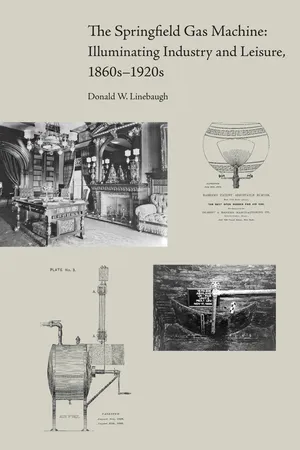
Developed just after the close of the Civil War, the Springfield Gas Machine was a unique commercial and domestic gas lighting system marketed for use in homes and businesses outside of a city’s gas works. The self-contained unit was perfectly suited to accommodate an expanding rural and suburban U.S. landscape as middle- and upper-class American families were looking to find simplicity in the countryside without losing any modern comforts of the city. Industries, too, were looking for a means to operate more efficiently and implement longer work hours for various production operations. Perhaps more important, owners of the Springfield system could retain control of their light production during a time when corporations were reaping large benefits from their monopolistic hold over municipal gas works.
In addition to detailing preserved Springfield systems across the country, Donald W. Linebaugh uses newspapers and magazine articles, advertisements, patents, and even mail-order catalogs to tell the story of this one-of-a-kind unit. The Gilbert and Barker Manufacturing Company's innovative business plan established them as a leader in the manufacture of gas lighting devices. By taking gasoline from an oft-discarded byproduct of refining crude oil to a viable fuel source, the company paved the way for other gas-powered appliances to improve household management strategies and industrial production. In capturing the pre-automobile market for gasoline, Gilbert and Barker attracted the attention of the Standard Oil Trust, presaging the oil-industry dominance over gasoline production that continues today.
The story of the Springfield gas machine ends in the early twentieth century as the advent of electricity proved more available to the masses with considerably less expense. However, gas lighting was, for its time, a major innovation in domestic and commercial lighting, and it changed daily life and social behaviors in the late nineteenth century as the comforts of home became a reality for suburban and rural Americans.
eBook - PDF
The Springfield Gas Machine
Illuminating Industry and Leisure, 1860s–1920s
- 362 pages
- English
- PDF
- Available on iOS & Android
eBook - PDF
About this book
Information
Table of contents
- Contents
- Acknowledgments
- Introduction
- Chapter 1: Lighting in America: From Rush Lamps to Gasoliers
- Chatper 2: The Gilbert and Barker Manufacturing Company
- Chapter 3: The Springfield Gas Machine
- Chapter 4: A Bright Light for the Home: Domestic Lighting with the Springfield Gas Machine
- Chapter 5: Extending the Day: Commercial and Institutional Springfield Systems
- Chapter 6: Gas Lighting Gives Way to Electricity
- Notes
- Bibliography
- Index
Trusted by 375,005 students
Access to over 1.5 million titles for a fair monthly price.
Study more efficiently using our study tools.
Frequently asked questions
Yes, you can cancel anytime from the Subscription tab in your account settings on the Perlego website. Your subscription will stay active until the end of your current billing period. Learn how to cancel your subscription
No, books cannot be downloaded as external files, such as PDFs, for use outside of Perlego. However, you can download books within the Perlego app for offline reading on mobile or tablet. Learn how to download books offline
Perlego offers two plans: Essential and Complete
- Essential is ideal for learners and professionals who enjoy exploring a wide range of subjects. Access the Essential Library with 800,000+ trusted titles and best-sellers across business, personal growth, and the humanities. Includes unlimited reading time and Standard Read Aloud voice.
- Complete: Perfect for advanced learners and researchers needing full, unrestricted access. Unlock 1.5M+ books across hundreds of subjects, including academic and specialized titles. The Complete Plan also includes advanced features like Premium Read Aloud and Research Assistant.
We are an online textbook subscription service, where you can get access to an entire online library for less than the price of a single book per month. With over 1.5 million books across 990+ topics, we’ve got you covered! Learn about our mission
Look out for the read-aloud symbol on your next book to see if you can listen to it. The read-aloud tool reads text aloud for you, highlighting the text as it is being read. You can pause it, speed it up and slow it down. Learn more about Read Aloud
Yes! You can use the Perlego app on both iOS and Android devices to read anytime, anywhere — even offline. Perfect for commutes or when you’re on the go.
Please note we cannot support devices running on iOS 13 and Android 7 or earlier. Learn more about using the app
Please note we cannot support devices running on iOS 13 and Android 7 or earlier. Learn more about using the app
Yes, you can access The Springfield Gas Machine by Donald W. Linebaugh in PDF and/or ePUB format, as well as other popular books in History & North American History. We have over 1.5 million books available in our catalogue for you to explore.