- 368 pages
- English
- PDF
- Available on iOS & Android
eBook - PDF
About this book
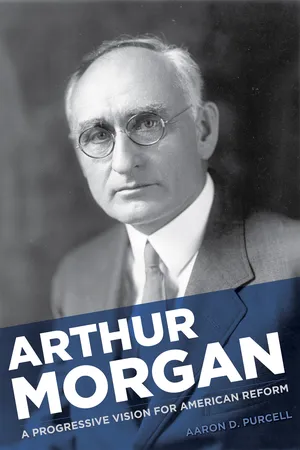
On May 19, 1933, President Franklin D. Roosevelt announced the appointment of Arthur Morgan (1878–1975), a water-control engineer and college president from Ohio, as the chairman of the newly created Tennessee Valley Authority (TVA). With the eyes of the nation focused on the reform and recovery promised by the New Deal, Morgan remained in the national spotlight for much of the 1930s, as his visionary plans for the TVA drew both support and criticism. In this thoughtful biography, Aaron D. Purcell re-assesses Morgan’s long life and career and provides the first detailed account of his post-TVA activities and fascination with utopian writer Edward Bellamy. As Purcell demonstrates, Morgan embraced an alternative type of Progressive Era reform throughout his life which was rooted in nineteenth-century socialism, an overlooked, but important, strain in American political thought.
Purcell pinpoints Morgan’s reading of Edward Bellamy’s Looking Backward while a teenager as a watershed moment in the development of his vision for building modern American society. He recounts Morgan’s early successes as an engineer, budding Progressive leader, and educational reformer; his presidency of Antioch College; and his revolutionary but contentious tenure at the TVA. After his dismissal from the TVA, Morgan wrote extensively, eventually publishing over a dozen books, including a biography of Edward Bellamy, and countless articles. He also raised money to support an experimental community in Kerala, India, sharing Mahatma Gandhi’s belief in small, self-sustaining communities cooperatively supported by persons of strong moral character. At the same time, however, Morgan retained many of his late-nineteenth century beliefs, including eugenics, as part of his societal vision. His authoritarian administrative style and moral rigidity limited his ability to attract large numbers to his community-based vision.
As Purcell demonstrates, Morgan remained an active reformer well into the second half of the twentieth century, carrying forward a vision for American reform decades after his Progressive Era contemporaries had faded into obscurity. By presenting Morgan’s life and career within the context of the larger social and cultural events of his day, this revealing biographical study offers new insight into the achievements and motivations of an important but historically neglected American reformer.
Purcell pinpoints Morgan’s reading of Edward Bellamy’s Looking Backward while a teenager as a watershed moment in the development of his vision for building modern American society. He recounts Morgan’s early successes as an engineer, budding Progressive leader, and educational reformer; his presidency of Antioch College; and his revolutionary but contentious tenure at the TVA. After his dismissal from the TVA, Morgan wrote extensively, eventually publishing over a dozen books, including a biography of Edward Bellamy, and countless articles. He also raised money to support an experimental community in Kerala, India, sharing Mahatma Gandhi’s belief in small, self-sustaining communities cooperatively supported by persons of strong moral character. At the same time, however, Morgan retained many of his late-nineteenth century beliefs, including eugenics, as part of his societal vision. His authoritarian administrative style and moral rigidity limited his ability to attract large numbers to his community-based vision.
As Purcell demonstrates, Morgan remained an active reformer well into the second half of the twentieth century, carrying forward a vision for American reform decades after his Progressive Era contemporaries had faded into obscurity. By presenting Morgan’s life and career within the context of the larger social and cultural events of his day, this revealing biographical study offers new insight into the achievements and motivations of an important but historically neglected American reformer.
Frequently asked questions
Yes, you can cancel anytime from the Subscription tab in your account settings on the Perlego website. Your subscription will stay active until the end of your current billing period. Learn how to cancel your subscription.
No, books cannot be downloaded as external files, such as PDFs, for use outside of Perlego. However, you can download books within the Perlego app for offline reading on mobile or tablet. Learn more here.
Perlego offers two plans: Essential and Complete
- Essential is ideal for learners and professionals who enjoy exploring a wide range of subjects. Access the Essential Library with 800,000+ trusted titles and best-sellers across business, personal growth, and the humanities. Includes unlimited reading time and Standard Read Aloud voice.
- Complete: Perfect for advanced learners and researchers needing full, unrestricted access. Unlock 1.4M+ books across hundreds of subjects, including academic and specialized titles. The Complete Plan also includes advanced features like Premium Read Aloud and Research Assistant.
We are an online textbook subscription service, where you can get access to an entire online library for less than the price of a single book per month. With over 1 million books across 1000+ topics, we’ve got you covered! Learn more here.
Look out for the read-aloud symbol on your next book to see if you can listen to it. The read-aloud tool reads text aloud for you, highlighting the text as it is being read. You can pause it, speed it up and slow it down. Learn more here.
Yes! You can use the Perlego app on both iOS or Android devices to read anytime, anywhere — even offline. Perfect for commutes or when you’re on the go.
Please note we cannot support devices running on iOS 13 and Android 7 or earlier. Learn more about using the app.
Yes, you can access Arthur Morgan by Aaron D. Purcell in PDF and/or ePUB format, as well as other popular books in History & Historical Biographies. We have over one million books available in our catalogue for you to explore.
Information
Table of contents
- Contents
- Acknowledgments
- Introduction
- 1. A Perilous Journey
- 2. Finding His World
- 3. Reform in Progress
- 4. Educating the Community
- 5. Valley of Visions
- 6. The Long Road Cut Short
- 7. Rediscovering the Utopians
- 8. I See a Village
- Conclusion
- Selected Bibliography
- Notes
- Index