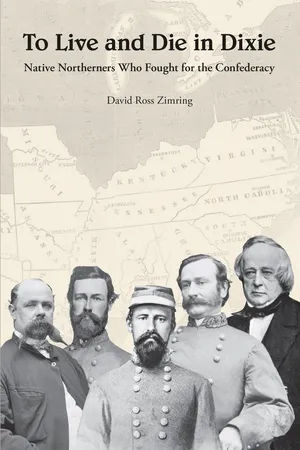
According to the 1860 census, nearly 350,000 native northerners resided in a southern state by the time of the Civil War. Although northern in birth and upbringing, many of these men and women identified with their adopted section once they moved south. In this innovative study, David Ross Zimring examines what motivated these Americans to change sections, support (or not) the Confederate cause, and, in many cases, rise to considerable influence in their new homeland. By analyzing the lives of northern emigrants in the South, Zimring deepens our understanding of the nature of sectional identity as well as the strength of Confederate nationalism.
Focusing on a representative sample of emigrants, Zimring identifies two subgroups: “adoptive southerners,” individuals born and raised in a state above the Mason-Dixon line but who but did not necessarily join the Confederacy after they moved south, and “Northern Confederates,” emigrants who sided with the Confederacy during the Civil War. After analyzing statistical data on states of origin, age, education, decade of migration, and, most importantly, the reasons why these individuals embarked for the South in the first place, Zimring goes on to explore the prewar lives of adoptive southerners, the adaptations they made with regard to slavery, and the factors that influenced their allegiances during the secession crisis. He also analyzes their contributions to the Confederate military and home front, the emergence of their Confederate identities and nationalism, their experiences as prisoners of war in the North, and the reactions they elicited from native southerners.
In tracing these journeys from native northerner to Confederate veteran, this book reveals not only the complex transformations of adoptive southerners but also the flexibility of sectional and national identity before the war and the loss of that flexibility in its aftermath. To Live and Die in Dixie is a thought-provoking work that provides a novel perspective on the revolutionary changes the Civil War unleashed on American society.
- 480 pages
- English
- PDF
- Available on iOS & Android
eBook - PDF
About this book
Information
Table of contents
- Contents
- Acknowledgments
- Introduction
- 1. Native Northerners Move South
- 2. From Northerner to Southerner
- 3. Adoptive Southerners React to Slavery
- 4. Adoptive Southerners Choose Sides
- 5. Adoptive Southern Unionists
- 6. Northern Confederates in War
- 7. Emergence of a Confederate Identity and Nationalism
- 8. Northern Confederate Prisoners of War
- 9. Native Southern Reactions toward Northern Confederates
- 10. The End of an Era: Northern Confederates in Reconstruction and Beyond
- Conclusion
- Appendices
- Notes
- Bibliography
- Index
Trusted by 375,005 students
Access to over 1.5 million titles for a fair monthly price.
Study more efficiently using our study tools.
Frequently asked questions
Yes, you can cancel anytime from the Subscription tab in your account settings on the Perlego website. Your subscription will stay active until the end of your current billing period. Learn how to cancel your subscription
No, books cannot be downloaded as external files, such as PDFs, for use outside of Perlego. However, you can download books within the Perlego app for offline reading on mobile or tablet. Learn how to download books offline
Perlego offers two plans: Essential and Complete
- Essential is ideal for learners and professionals who enjoy exploring a wide range of subjects. Access the Essential Library with 800,000+ trusted titles and best-sellers across business, personal growth, and the humanities. Includes unlimited reading time and Standard Read Aloud voice.
- Complete: Perfect for advanced learners and researchers needing full, unrestricted access. Unlock 1.5M+ books across hundreds of subjects, including academic and specialized titles. The Complete Plan also includes advanced features like Premium Read Aloud and Research Assistant.
We are an online textbook subscription service, where you can get access to an entire online library for less than the price of a single book per month. With over 1.5 million books across 990+ topics, we’ve got you covered! Learn about our mission
Look out for the read-aloud symbol on your next book to see if you can listen to it. The read-aloud tool reads text aloud for you, highlighting the text as it is being read. You can pause it, speed it up and slow it down. Learn more about Read Aloud
Yes! You can use the Perlego app on both iOS and Android devices to read anytime, anywhere — even offline. Perfect for commutes or when you’re on the go.
Please note we cannot support devices running on iOS 13 and Android 7 or earlier. Learn more about using the app
Please note we cannot support devices running on iOS 13 and Android 7 or earlier. Learn more about using the app
Yes, you can access To Live and Die in Dixie by David Zimring in PDF and/or ePUB format, as well as other popular books in History & American Civil War History. We have over 1.5 million books available in our catalogue for you to explore.